


LONG EDGE · SHORT EDGE · VISIBLE PAGES UNCHANGED
Add a duplex printing preference to a PDF
Write long-edge or short-edge ViewerPreferences into a new PDF without adding, rotating, reordering, scaling or rasterizing visible pages.
PDF duplex metadata is a preference for compatible viewers and print drivers. Choose long edge for a typical portrait book stack or short edge for a typical landscape stack, then download a visually unchanged PDF. The hint can improve defaults, but it cannot force every copier to print two-sided. The operator must still confirm the print dialog.
Guide last checked and updated October 11, 2026 by the 55printing prepress team.
Pick your path
Two ways to get this done - both 100% free
Complimentary prepress service
Send us your files - we'll handle Add a duplex printing preference to a PDF
Use our File Uploader to send artwork and notes. Our team will complete this task and email you back completely free of charge.
- Upload the approved PDF
- Say whether the flip should be long edge or short edge
- Ask us to stamp the preference without moving the pages
FREE DUPLEX PREFERENCE WRITER
Choose the intended physical flip edge
No upload · visible pages are not rebuilt
Metadata changes the suggestion, not the sheet
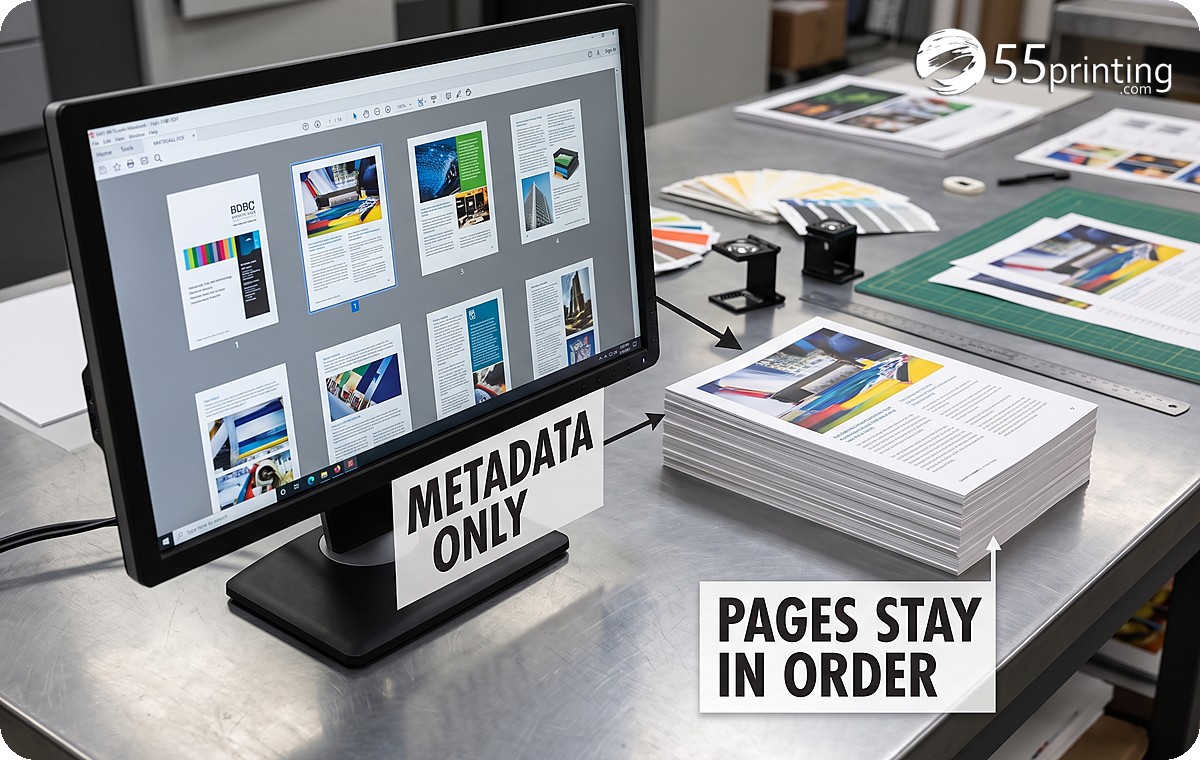
The converter writes ViewerPreferences DuplexFlipLongEdge or DuplexFlipShortEdge. It does not duplicate pages or create fronts and backs. The existing order remains the duplex stack: page 1 fronts page 2, page 3 fronts page 4, and so on.
A compliant viewer may preselect the requested edge. Another driver may ignore it. This is why the result always states that visible pages are unchanged and the operator still owns the final device setting.
How to add duplex metadata
- Confirm the page stack. Use Duplex Readiness to inspect pairing, orientation and odd-page risk.
- Choose a flip edge. Select the edge that keeps the physical backs upright for the binding direction.
- Open and print a sample. Verify the download looks identical, then select two-sided on the target printer.
Pick the intended duplex preference
| Preference | Typical stack | Still required |
|---|---|---|
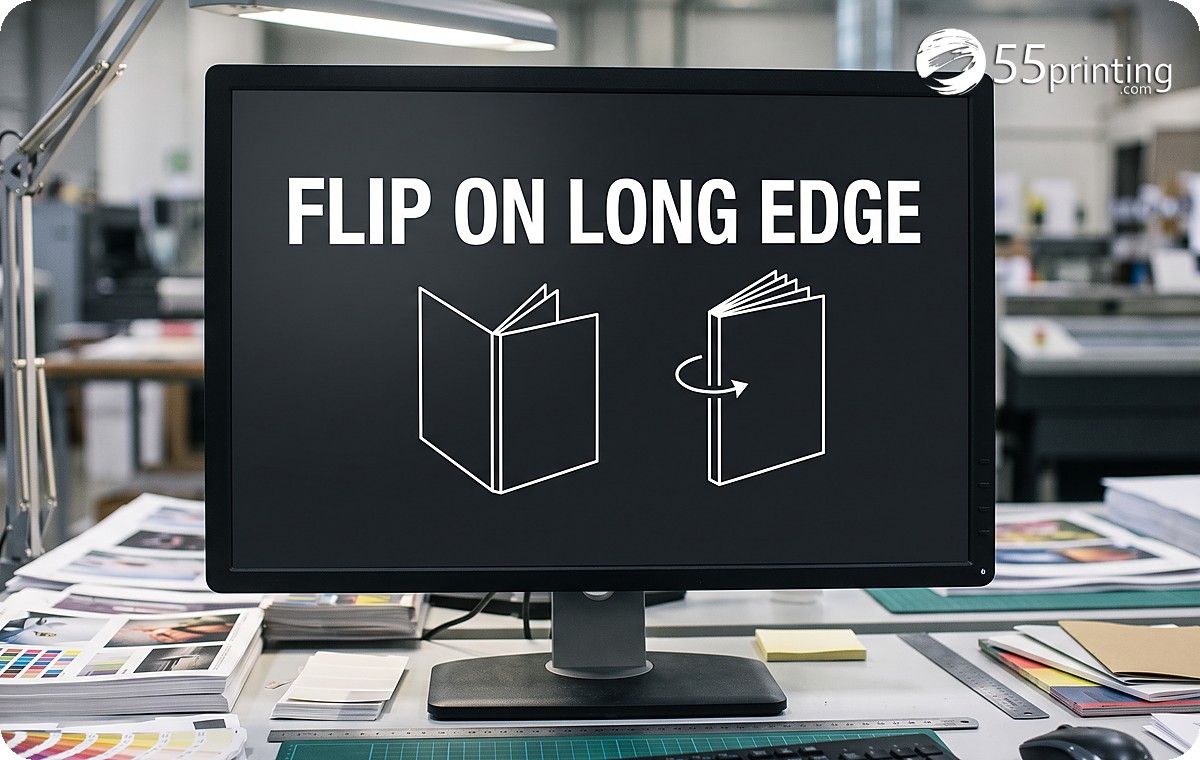
| Long edge | Portrait pages turning like a book | Select two-sided and proof backs |
| Short edge | Landscape pages turning on the short side | Select two-sided and proof backs |
| No preference | Driver chooses its default | Set every option manually |
Duplex metadata questions
What does duplex metadata change?
It changes the PDF catalog ViewerPreferences entry for Duplex. The selected value requests long-edge or short-edge flipping in compatible software. It does not change page artwork, count, order, dimensions or visible rotation. Compare the source and the download page by page before you send the file to a copier.
Will the printer automatically use duplex after this?
Not reliably. Some viewers and drivers use the preference as a default, while many production copiers require the operator to select two-sided printing. Treat the metadata as a helpful hint and verify the actual print settings. Print one front-and-back sheet on the device that will run the job.
Does the converter add blank pages?
No. It leaves page count and order unchanged. If an odd-page document needs an intentional blank back, add or approve that page before stamping metadata so later jobs do not shift the intended front-and-back pairs. Check the duplex readiness report when the count is odd.
Which option should I choose for portrait pages?
Long edge is the common book-style choice for upright portrait pages. Binding direction and printer wording can differ, so print one front-and-back sample and confirm that the back reads upright before producing the full quantity. Do not trust the menu name until that sheet is in your hands.
Which option should I choose for landscape pages?
Short edge is the common choice for landscape pages when they should turn like a horizontally bound book. If the job is top-bound or has mixed orientation, inspect the physical reading direction instead of relying on the common default. Mixed stacks need the mixed-page tool before this stamp.
Can I remove or change the preference later?
Yes. Run the original or previously stamped PDF through the tool again with the desired edge, or print with a manual override. Keep the untouched source because it remains the safest reference for page-content comparisons. A second pass replaces the hint. It does not stack a second copy of the pages.
We write the flip hint without touching the pages the customer approved
A two-sided brochure was approved, then the copier opened it as single-sided because the PDF never asked for duplex. We stamped long-edge on a copy of that file. The pictures did not move, the page count did not change, and we still had the operator select two-sided in the dialog. The stamp is a hint. It is not a promise that every RIP will obey it.
55printing uses this stamp when the visible art is already correct and only the preference is missing. We keep the untouched source in the folder. Daily. No ceiling.
Does 55printing stamp duplex metadata on approved files?
Yes, when the pages are already approved and the only missing piece is a long-edge or short-edge hint. We do not reorder or rasterize those pages. The operator still selects two-sided printing, because many copiers ignore ViewerPreferences.
A metadata stamp still needs the readiness report first
Check pairs and odd backs with the duplex readiness tool before you write the preference. Mixed page directions belong on the mixed-page bench, not inside this stamp.
Create & Design
- Online Designer - Free browser design studio for cards, flyers, and more
- Guideline Templates - Bleed and safe-zone files for popular print sizes
- Paper Types Gallery - See which products use each stock, plus similar-paper picks
- AI Design Help - Staff-assisted AI help for logos and artwork
- All languages - Design, print, chat, and email in any language
- QR Code Generator - Create a free custom QR code for print
- QR Code Scanner - Test if a printed or file QR is readable and what it opens
- Free Sample Kit - Feel our paper, coatings, and finishes, mailed to your door
Files & Proofs
- Print Clear: Print Resolution Checker - Check effective PPI, print size fit and color signals before printing
- Rotate Files: PDF, JPG & PNG - Turn a file 90°, 180° or 270° in your browser without uploading it
- True Size Letter PDF - Center pages on Letter at true 1:1 size without scaling
- Mixed Page Landscape Fit - Preserve landscape pages and turn mismatched portrait pages left
- PDF Punch Clearance Guide - Plan an adjustable binding-side band and three-hole guide
- PDF Bleed Box and Edge Ink - Inspect PDF boxes and rendered ink near every edge
- PDF Duplex Readiness - Inspect page count, orientation, blank backs and duplex flags
- PDF to Real DeviceGray - Rasterize selected or all pages to true 8-bit DeviceGray
- Print Ready Preflight Check - Check dimensions, bleed planning and effective PPI before printing
- Business Card Print-Safe Check - Check the 3.5 × 2 inch card plan, bleed and image detail
- EDDM Mailpiece & Indicia Checker - Check USPS flat size, thickness, audience and indicia planning
- QR Print Readiness Checker - Decode a QR and check printed size, contrast and quiet zone
- File Uploader - Upload artwork or request a free file review
- Artwork Quality Enhancer - Restore blurry text, weak edges, and low-resolution print files
- Low-Res Text Recovery - Recover blurry text on photos, foil, and any background
- Color Profile Check - Check if a PDF is CMYK or RGB, plus the ICC profile and output intent
- Word to PDF - Convert DOC and DOCX to high-fidelity print PDF
- PDF to JPG - Export PDF pages as JPG or PNG at print DPI
- Images to PDF - Merge JPG, PNG, WebP, and PDF into one file
- Grammar Check - AI spelling and clarity check for print copy
- AI Uncrop Image - Free local image uncrop; AI extend by request
- Free PDF Proof - Get a digital proof before you place an order
- PowerPoint to JPG/PDF - Turn slides into print pages and proof images.
Plan & Budget
- Print Cost Per Piece Calculator - Model transparent setup, materials, finishing, mailing and postage assumptions
- Direct Mail ROI Calculator - Model response, conversion, CPA and break-even before a mail drop
Order & Pay
- Online Payment - Pay an invoice with card, PayPal, or wallets
- Pay Later - Order now and pay after you approve the proof
- Price Match - Ask us to review a lower competitor price
Samples & Support
- Custom Quotes - Get a written quote for special sizes, finishes, and large runs
- Custom Orders - Special sizes, finishes, or design requests
- Contact - Reach our print specialists by phone or form