

Business Card vs Postcard: Same Brand, Different Canvas
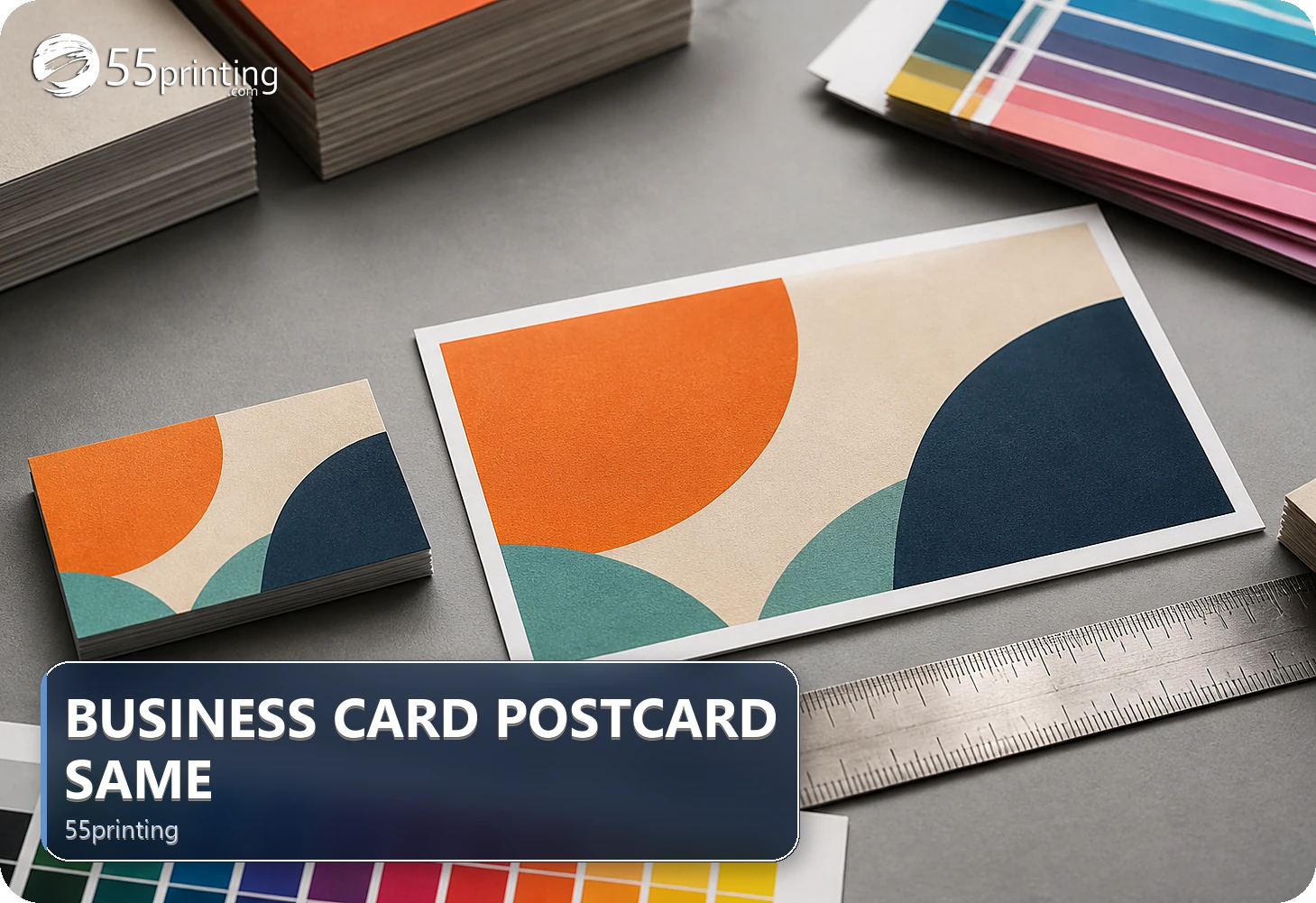
Keep the approved brand identity, copy authority, and asset roles consistent, then rebuild the hierarchy for each product. A business card concentrates identity and contact information; a postcard has a different canvas, message, crop, reading distance, and mailing context. Use the current template for each product and proof each adapted file separately.
The 55printing Guideline Templates path helps separate product geometry from brand decisions. Start with the approved logo, copy, colors, and imagery, then choose the current business-card or postcard template. For a standard 3.5 by 2 inch card file, the free Business Card Print-Safe Check reviews the card plan, bleed, and image detail before you rebuild the same brand on a postcard. The proof path should compare each product in its own context rather than assuming that a good card layout will remain correct after a canvas change.
What changes when the brand moves between products?
Brand consistency covers identity rules and approved assets; it does not fix the hierarchy, crop, reading order, or safe zones for a different product. Record which elements must remain recognizable and which elements can be rebalanced for the new canvas. Start with the product, side, orientation, and intended first-read message.
| Product context | First question | Adaptation focus | Risk if copied |
|---|---|---|---|
| Business card | What contact or identity is first? | Compact hierarchy and legible contact details | Tiny copy or crowded spacing. |
| Postcard front | What message is first at a glance? | Headline, image, offer, and response path | Card hierarchy can feel too small or dense. |
| Postcard back | What information belongs in each zone? | Copy, address, response, and safe placement | Content can cross a risky area or lose order. |
| Shared brand system | Which elements are authoritative? | Logo, colors, type roles, and approved copy | Brand identity changes during reformatting. |
How should a card layout be adapted into a postcard?
Preserve the approved identity and message authority, but re-evaluate hierarchy, image crop, contact detail, response path, and product zones. Do not stretch the card, scale every element proportionally, or fill open space with unapproved copy. Build the postcard from its current template, then compare the first-read result in proof.
- List protected brand elements.
- Choose the current product template.
- Set the new first-read message.
- Rebuild hierarchy and crop.
- Protect copy and safe areas.
- Proof the adapted front and back.

What should the handoff note protect?
Name the source version, product, side, approved logo and copy, protected brand elements, new hierarchy, image crop, template, and proof questions. State which content is intentionally removed or moved. Keep screenshots and old proofs as references, and keep the authoritative source identifiable in the File Uploader note.

How should each product be proofed?
Use the free PDF proof to compare exact copy, logo identity, image crop, product size, orientation, bleed, safe zone, hierarchy, and page or side order. Ask separate questions for the card and postcard. A proof can reveal that the same brand assets need different spacing or copy treatment; it should not be used to justify guessed content.
Which same-brand adaptations need extra care?
Contact-heavy business card
Keep name, role, phone, email, and approved identity clear. Check line breaks, hierarchy, and safe placement against the card template.
Campaign postcard
Choose one first-read message, protect the image crop, and place response or address content according to the postcard template. Do not carry every card detail onto the mailer.
Shared QR destination
Use the approved destination and test it independently for each layout. A code that fits a card can sit too close to a postcard crop or mail panel. Run the free QR print readiness checker for size, contrast, and quiet-zone planning, then the free print-file QR scanner to confirm the file contains a real scannable code. Review placement in each product proof.
Questions customers ask
Can I use the same design on both products?
Use the same approved brand identity and content authority, but adapt hierarchy, crop, spacing, safe zones, and reading order to each product. A business card and postcard answer different first-read questions. Build each from its current template and proof both files separately.
What should stay consistent?
Keep the approved logo identity, brand colors, type roles, exact copy authority, image authority, and destination authority consistent unless a new decision is documented. Consistency does not require identical placement or scale. Record which elements are protected before adapting the canvas.
Why does a postcard need a new hierarchy?
A postcard has a different canvas and communication context from a business card. Its first-read message, image, response path, address or back-side zones, and safe areas can change. Reassess the order instead of shrinking the card’s dense contact block into the postcard.
Should I stretch the business card?
Do not assume proportional stretching preserves crop, spacing, safe zones, or readable hierarchy. Start with the current postcard template, place the approved content, and rebuild the layout for that product. Use proof to check the result in context before handoff.
Can the same QR code be used?
The same approved destination may be used when that is intentional, but test and proof each placement separately. Check quiet space, contrast, crop, surrounding copy, and product context. A code that looks correct in one layout can be compromised by a different crop or placement. The free QR print readiness checker and print-file QR scanner cover planning and file readability; they do not approve the postcard layout.
Does the business card checker also approve the postcard?
No. The Business Card Print-Safe Check reviews a 3.5 by 2 inch card plan, bleed, and image detail. A postcard uses a different canvas, reading order, and often a mail side. Keep the card result as evidence for the card file, then place the brand on the current postcard template and run print preflight plus a separate proof.
What belongs in the handoff note?
Name the brand source, product, side, current template, approved copy, protected elements, changed hierarchy, image crop, QR destination, source version, and proof questions. State which card elements were removed or moved. This prevents the reviewer from treating the postcard as a copied card file.
Does proof approve brand consistency?
Proof can compare logo identity, color appearance, copy, crop, placement, hierarchy, product size, and safe areas. It cannot establish that an unknown logo or unapproved copy belongs to the brand. Provide the authoritative source and ask proof questions tied to each product.
What if the postcard needs different copy?
Provide the exact approved postcard copy and identify the business-card copy as reference. Do not invent a campaign message to fill open space. Review the new hierarchy, line breaks, crop, response path, and product zones in the postcard proof.
Protect the approved identity, rebuild hierarchy for the product, and proof the card and postcard as separate decisions.