

LAST UPDATE: 10 / 21 / 2026
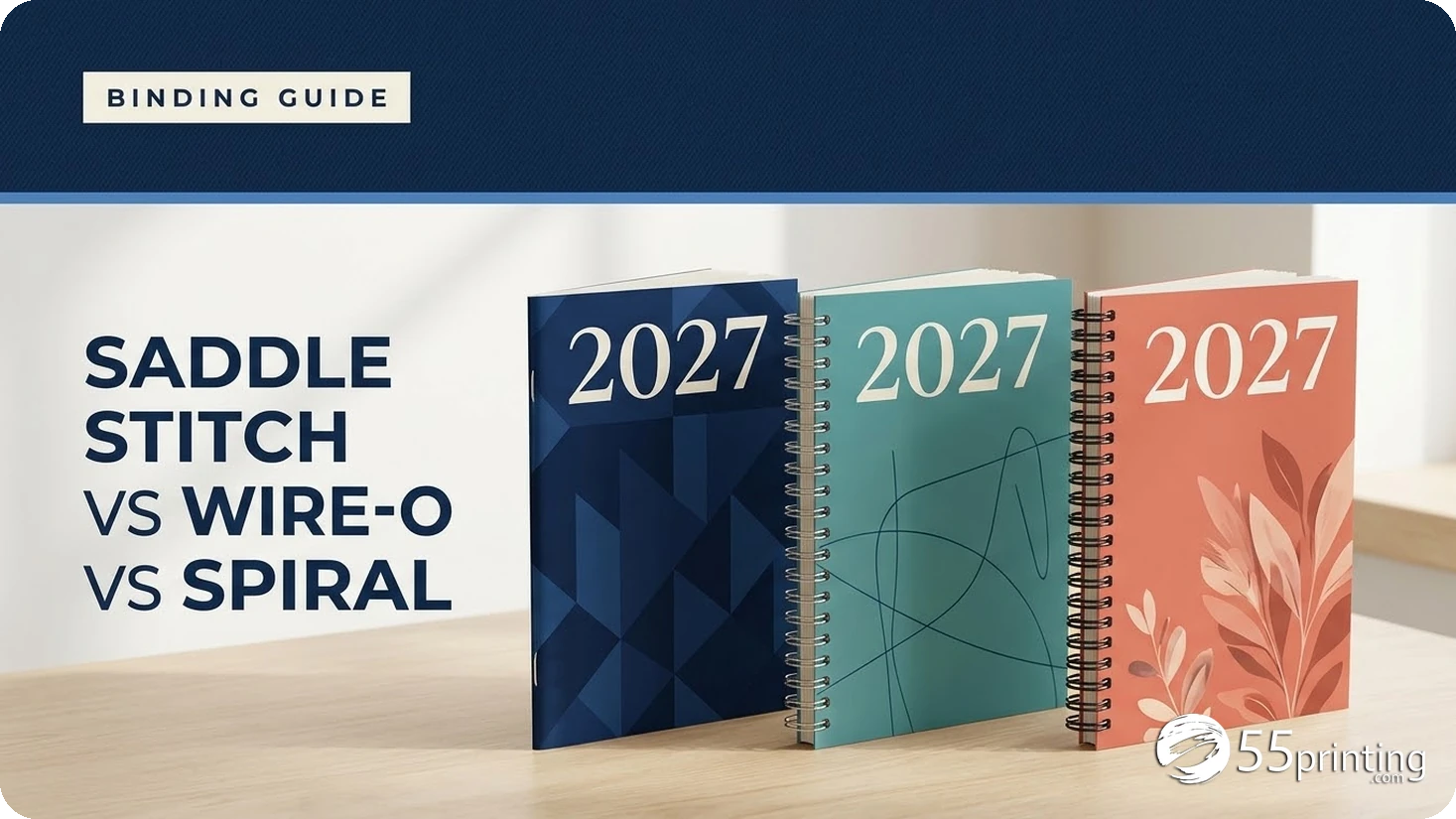
Saddle stitch vs wire-o vs spiral: saddle stitch is the low-cost binding that staples the spine, best at 12 to 32 pages on this form from $699.33 print at 500. Wire-o and spiral hang flat and look premium but cost more; a specialist can quote those. Our form sells saddle stitch only.
A print buyer pricing a 500-piece client gift is staring at three binding options across three different quotes. The saddle stitch vs wire-o decision decides not just the look but the page count the calendar can hold, whether it hangs flat, and how much it costs per book. Here is what each binding actually is and which one this form prints.
Saddle stitch vs wire-o vs spiral: what each binding is
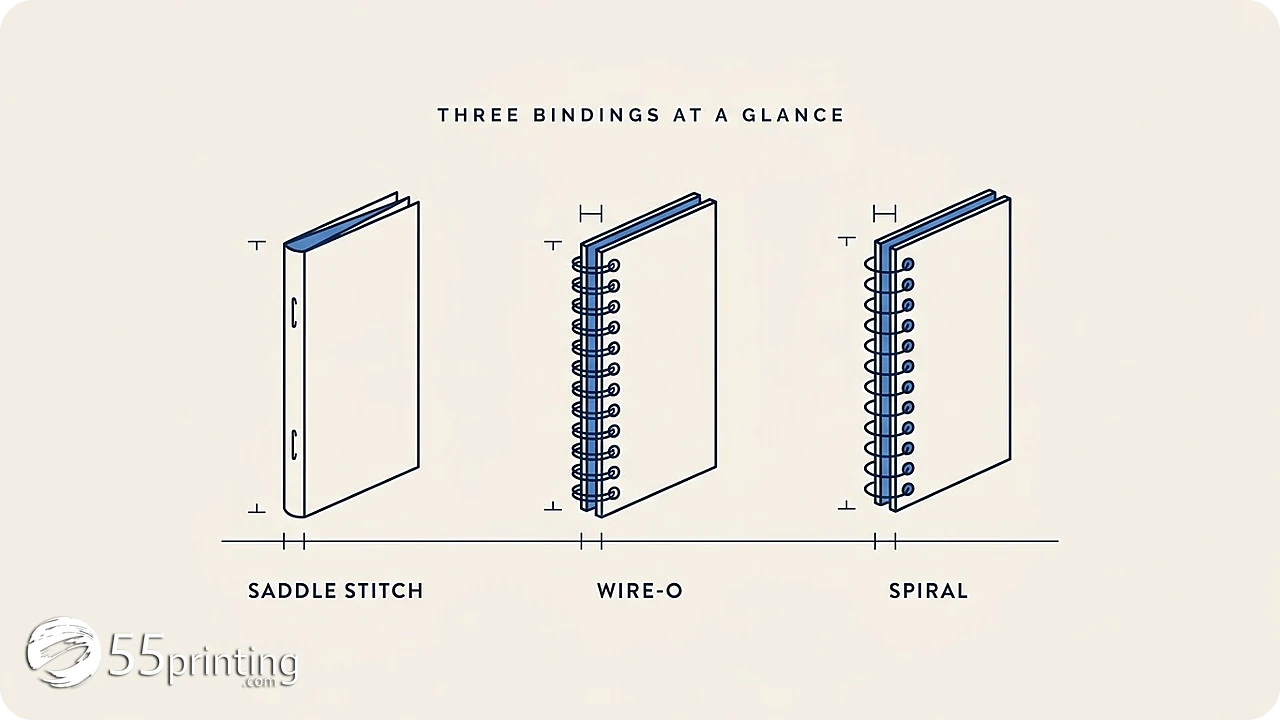
Three bindings cover nearly every printed calendar a business orders. They differ in how the pages attach, how the book hangs on a wall, and what a run of 500 costs.
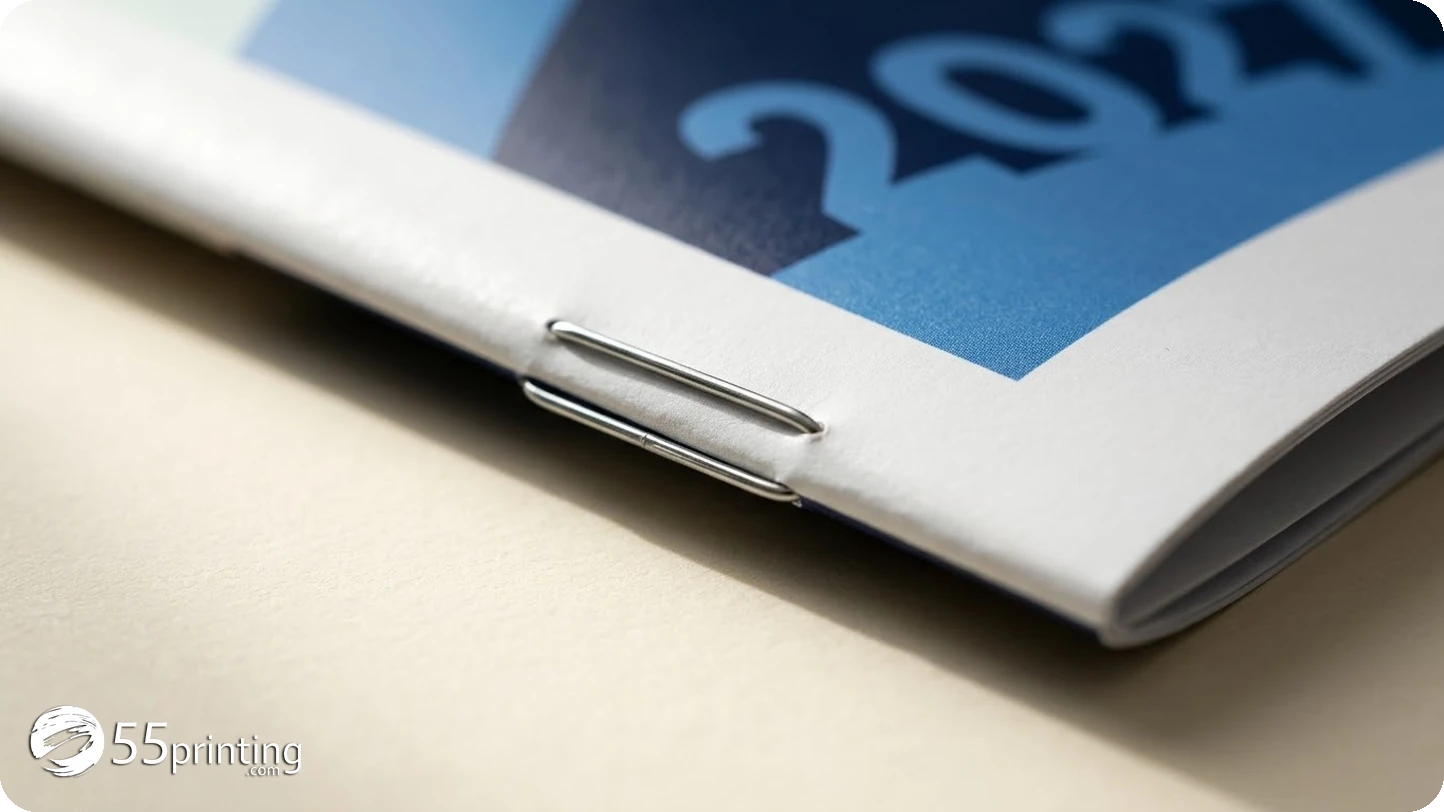
Saddle stitch takes printed sheets, collates them, drives two or three wire staples through the fold line at the spine, then folds and trims the whole book flat. It is the classic booklet bind: thin, light, cheap, and the standard for calendars under about 64 pages.
Wire-o punches a row of small holes along the edge and threads a double-loop wire through them. The pages turn 360 degrees and the book folds back on itself, which is why it dominates desk calendars and premium wall calendars.
Spiral punches the same holes and winds a continuous plastic coil through them. Same flat-fold behavior as wire-o, softer look, slightly different cost profile.
Saddle stitch: what it does well and where it stops
On the saddle stitch vs wire-o question, saddle stitch wins on cost and loses on lay-flat. The strengths: it is the lowest-cost binding at volume, it needs no extra binding material beyond the staples, it mails flat and light, and on this form it runs at 500 to 10,000 pieces. The page count, including the 4 cover pages, has to be divisible by 4, which is why the form offers 12, 16, 20, 24, 28, and 32 pages.
The limits are real. A saddle-stitched book does not fold all the way back on itself the way a wire-o does, so a wall calendar that hangs open shows both pages of a spread at once. Thick books creep: on a 32-page run the inner pages sit a little shorter at the fore-edge, which the trim accounts for but a careful eye can spot. And the staples are the whole bind, so a very heavy paper on a big page count is where saddle stitch starts to feel strained.
How a saddle-stitched calendar is actually made
Print the flat sheets with two months per leaf, collate them in order, drive the staples through the spine fold, fold the stack in half, then trim the three open sides. The whole operation is fast, which is part of why it prices the way it does.
That process is also why a saddle-stitched calendar is the forgiving choice on paper stock. The staples are small and the fold is clean, so the form’s regular papers handle the bind without special instructions, and the 0.05 inch bleed keeps every photo edge clean after the trim.
Stapled spine, thin profile, lowest cost. Holds 12 to 32 pages on this form. Hangs with a drilled hole or a thumbtack through the cover.
Double-loop wire through punched holes. Folds flat back on itself, 360-degree page turn, premium look. Higher cost; a print specialist quotes it through the contact page.
Continuous plastic coil through punched holes. Same flat-fold behavior as wire-o, softer look, similar cost. Not on this form; a specialist can quote it.
Wire-o and spiral: the flat-fold bindings
Wire-o and spiral exist to solve one problem saddle stitch cannot: a calendar that opens flat and folds back on itself so only one page shows at a time. That is the desk-calendar behavior buyers picture when they imagine a calendar on a stand, and it is the reason premium wall calendars often carry a wire loop.
On the saddle stitch vs wire-o trade, wire-o costs more for two reasons: the wire itself is a bought component, and the punching and looping is a second bindery step after the book is assembled. Spiral behaves the same with a plastic coil. We do not quote their prices here because they are not on this form, and a guessed price would be worse than none. For either binding, send the size, page count, and quantity through the contact page and a print specialist will quote the real number.
Pages, turns, and how a calendar hangs
Page count rules each binding. Saddle stitch needs a leaf-based page count: the form’s options of 12, 16, 20, 24, 28, and 32 are all divisible by 4, because each printed sheet folded in half makes 4 pages. Wire-o and spiral carry larger page counts without the divisibility rule, and they let a book open flat at any page.
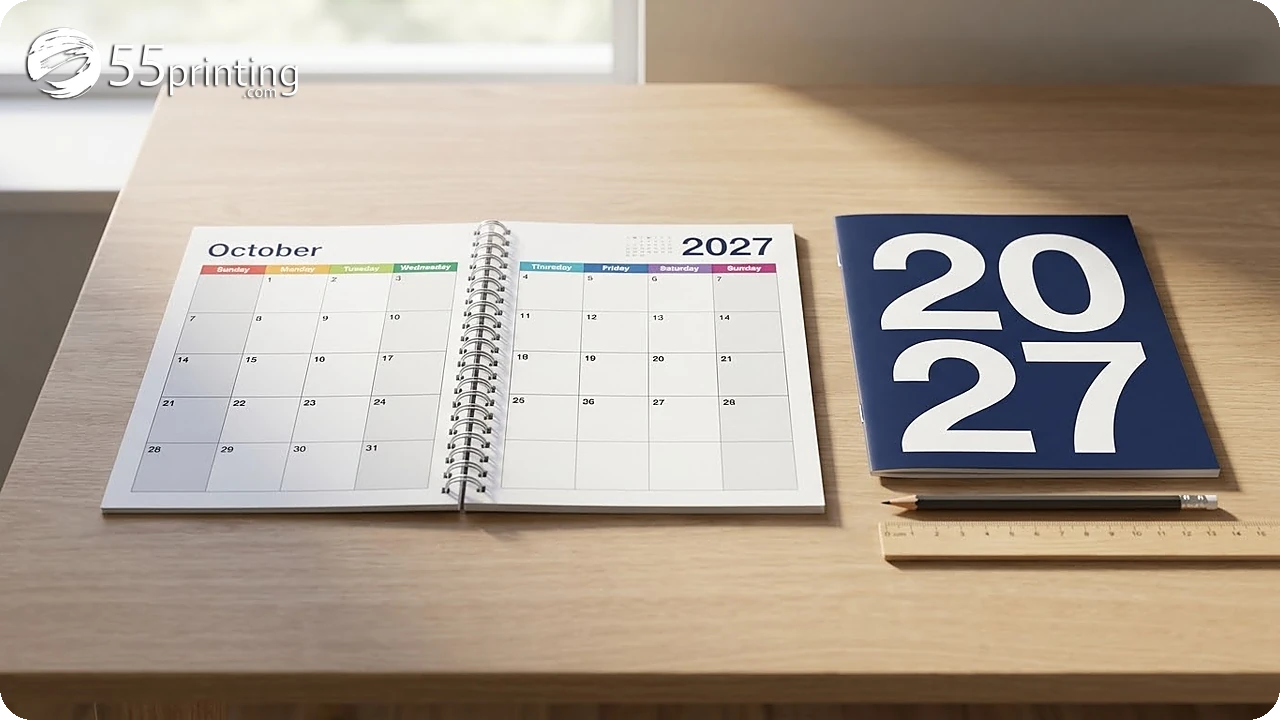
Hanging behavior differs too. A saddle-stitched calendar hangs best with a drilled hole or a thumbtack through the top of the open book, and the spread shows two pages. A wire-o or spiral calendar folds back so a wall or desk shows one page at a time.
What saddle stitch costs at our run sizes
Since saddle stitch is the binding on this form, here is its real cost (default papers, Ground to 33140, checked October 2026). Wire-o and spiral pricing belongs to a specialist quote.
| Page count | Print at 500 | Landed at 500 |
|---|---|---|
| 12 pages | $699.33 | $761.23 |
| 16 pages | $841.94 | $916.95 |
| 32 pages | $1,642.28 | $1,774.98 |
The page-count jump is the real cost driver, not the binding: 12 to 16 pages adds $142.61 at 500, and 16 to 32 pages adds $800.34. A seller who needs flat-fold behavior pays more for wire-o or spiral elsewhere; a buyer who just needs the dates, the logo, and a clean hang pays less here.
Which binding for which job
The practical pick: saddle stitch for a business giveaway, a fundraiser, a recall calendar, or a client gift at 500 to 10,000 pieces, where cost per piece matters most. Wire-o for a premium desk calendar or a branded wall calendar where the flat fold is the point of the gift. Spiral where a softer coil look fits the brand better than wire.
One honest note on saddle stitch vs wire-o for the specific job of a 12-month wall calendar: the stapled spine is what keeps the price at $1.52 to $1.83 landed at 500, and it is what a real print shop uses for runs like this. The wire and coil options are the right answer for a different buyer with a different budget.
Download the binding cheat sheet

Saddle stitch vs wire-o vs spiral: common questions
What is saddle stitch binding?
Saddle stitch binds a book by driving two or three wire staples through the fold at the spine. The printed sheets are collated, stapled at the fold line, then folded flat and trimmed. On this form it holds 12 to 32 pages and prints 500 twelve-page calendars at $699.33.
Is wire-o better than saddle stitch for calendars?
Wire-o is better at one thing: it folds back on itself so a desk calendar shows one page. Saddle stitch is better on cost at volume and holds 12 to 32 pages cleanly. The saddle stitch vs wire-o answer is the job: flat-fold desk behavior argues wire-o, cost-per-piece argues stitch.
Why does my calendar page count have to be divisible by 4?
Because saddle stitch binds folded sheets. One printed sheet folded in half makes 4 pages, so the total must be a multiple of 4. That is why this form offers 12, 16, 20, 24, 28, and 32 pages and nothing in between.
Can a saddle-stitched calendar lay flat?
Partly. A saddle-stitched book opens flat on a table, but it does not fold all the way back on itself the way a wire-o or spiral does. Hung on a wall by a drilled hole it shows both pages of a spread at once, which is normal for a printed calendar of 12 to 32 pages.
What is the bleed for a saddle-stitched calendar on this form?
0.05 inches on every side, so the file size is 6.1 x 9.6 inches for the 6 x 9.5 trim. Keep text and logos inside the cyan safe line on the guideline files. That bleed is ours; shops that use different equipment may spec a different bleed on their own wire-o work.
How much does a 32-page saddle-stitched calendar cost?
At 500 it prints at $1,642.28 and lands at $1,774.98 with Ground to 33140. That is the longest run on the form and shows saddle stitch holding a heavier book cleanly. Anything past 32 pages wants a different bind and a specialist quote.
Do you offer wire-o or spiral calendars?
Not on this form. The online calculator prices saddle-stitched 6 x 9.5 inch books only. Wire-o and spiral are real products with real extra cost, and a print specialist can quote them with the size, page count, and quantity through the contact page.
Does the binding change the production time?
For saddle stitch, no: Regular Production is 3 to 5 business days plus 1 to 6 estimated days of Ground transit regardless of page count. Wire-o and spiral add a bindery step and their own timing, which is part of the specialist quote rather than a number we can give here.
500 twelve-page books print at $699.33, and the calculator prices every page count and quantity with shipping shown before checkout.