

LAST UPDATE: 10 / 06 / 2026
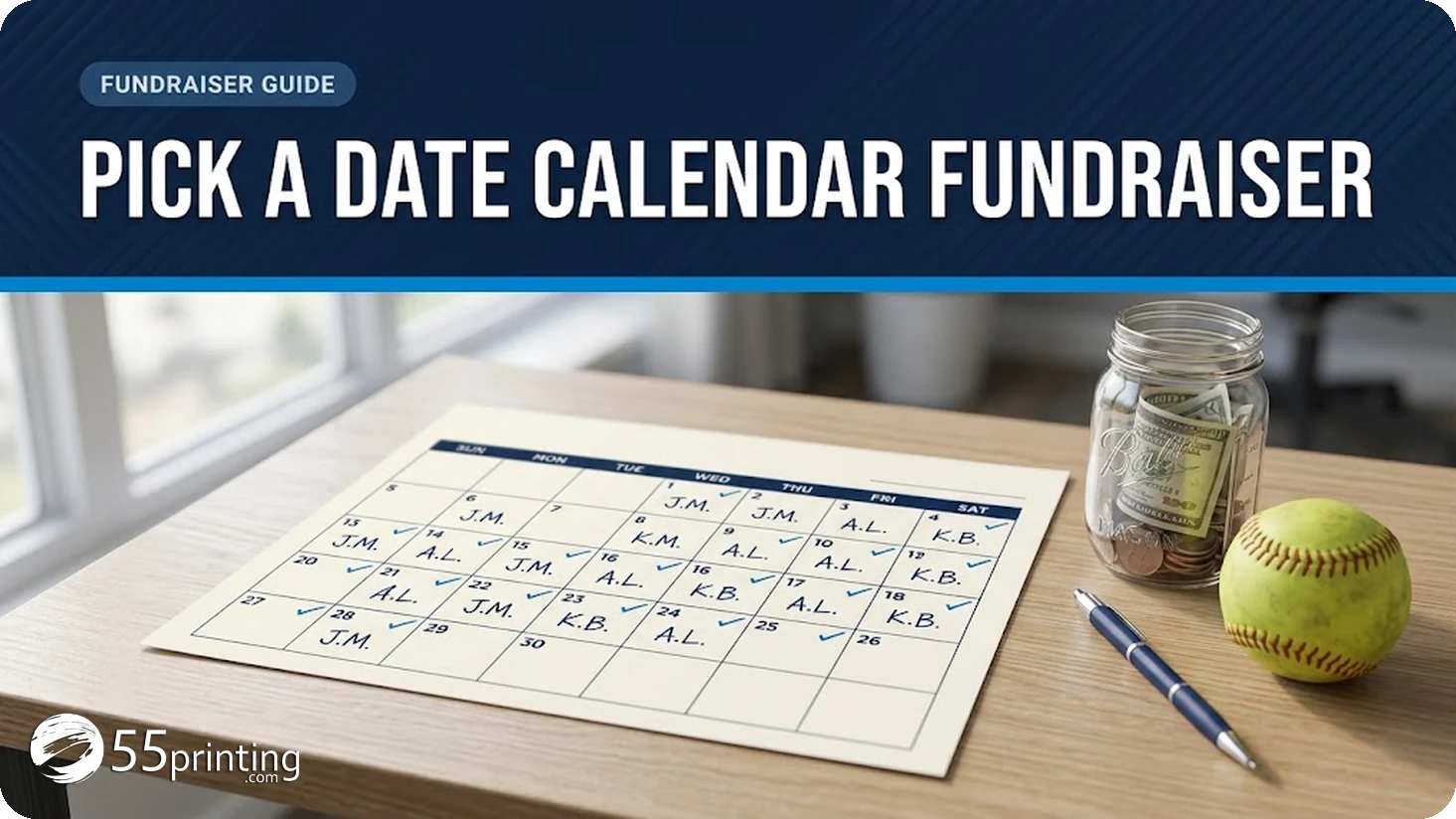
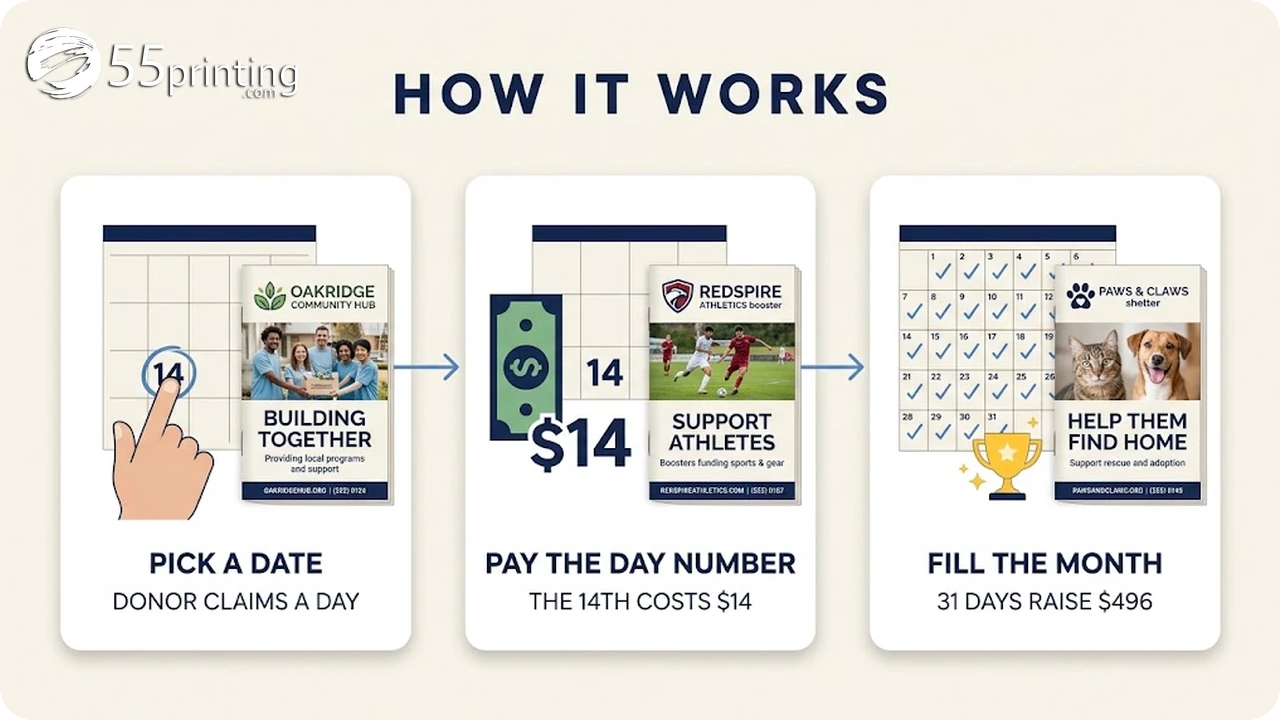
A pick-a-date calendar fundraiser gives each seller a printed month grid. Donors pick any open date and donate that day number in dollars, so the 4th costs $4 and the 27th costs $27. Fill all 31 days and one calendar raises exactly $496, and because donors give instead of winning prizes, the format sidesteps most raffle licensing questions.
A softball team needs $4,000 for a spring tournament. Instead of selling candy, each of the 15 players takes home a printed January calendar and asks family, neighbors, and coworkers to pick a date. Pick the 9th and you donate $9; pick the 30th and you donate $30. When a player’s grid is full, they have raised $496 and the team is most of the way to its goal. That is the whole mechanic of a pick-a-date fundraiser, sometimes called sponsor-a-day or pay-the-date. This page covers the math, why it is easier to run than a raffle, the sport variants people search for, and how to print the grids.
How a pick-a-date fundraiser works
Each seller carries one printed calendar grid for a specific month. They ask a supporter to pick any open date and donate that day number in dollars. The donor writes their initials or name in the claimed cell so nobody picks it twice, pays the seller by cash or the group’s payment app, and the seller moves on to the next ask. There is no prize, no draw, and no follow-up: the donation is the transaction.
Groups run it two ways. Some give every player one calendar to fill alone, which works for teams of 15 to 25 where each family has a big enough circle. Others run a shared calendar for the whole group at a table or on social media, where the post shows the grid and donors comment or message their date. Both work; the per-player version raises more because every seller works their own network at the same time.
The $496 math on a full month
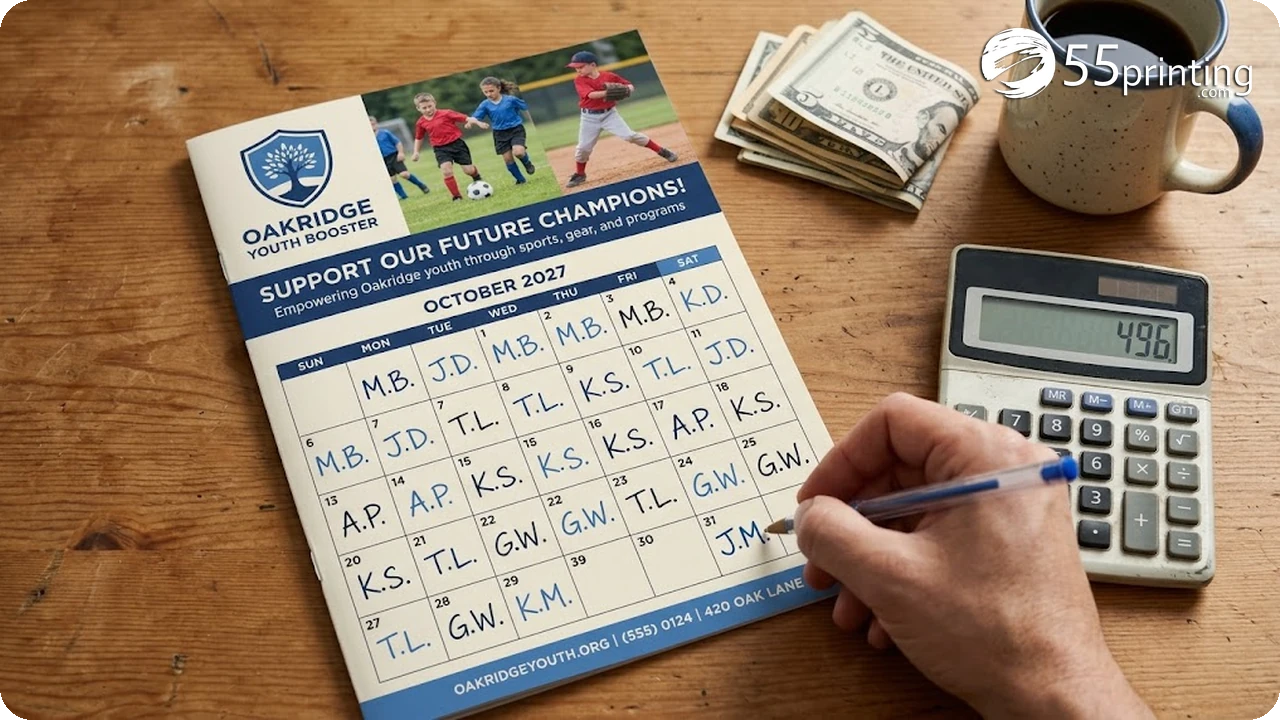
The total of a filled calendar is the sum of the day numbers, which is fixed the moment you pick the month. A 31-day month sums to 1 + 2 + 3 all the way to 31, which equals exactly $496. A 30-day month tops out at $465, and February’s 28 days sum to $406. Most groups pick a 31-day month like January, March, or May to get the biggest headline number.
| Grid | Full calendar raises | Best use |
|---|---|---|
| 31-day month | $496 | January, March, May, July, August, October, December |
| 30-day month | $465 | April, June, September, November |
| February, 28 days | $406 | Quick runs inside a season |
Now multiply by sellers. Fifteen players each filling a January calendar raise $7,440 before costs, and the printing for 15 grid sheets is under $10 on any copy counter. Teams who want a bigger number run two calendars per player or open a second month. The math is so clean that many groups print the target right on the sheet: fill this calendar, raise $496.
Why it is easier than a raffle calendar
Our lottery calendar fundraiser guide covers the daily-draw raffle format, which is a great mechanic but a regulated one: it is a game of chance, and most states want a licensed nonprofit behind it. Pick-a-date flips that. Nobody wins anything, so there is no prize schedule, no draw, and in most places no gaming license question at all. It is a straight donation drive wearing a calendar costume.
That difference changes who can run it. A 12U travel team, a cheer squad, a school club, or a dance studio can launch pick-a-date with a stack of printed grids and a payment app, no treasurer paperwork beyond counting the money. Sellers also love it because the ask is tiny and specific: saying pick a day, whatever fits your budget converts better than asking for a flat $20, because the donor chooses the amount.
The sport and group variants people run
Search data says this format belongs to youth sports. Softball, baseball, and soccer teams are the biggest users, and the calendar is usually themed to the team: a softball pick-a-date sheet carries the team name, colors, and a ball graphic; a cheer fundraiser grid swaps in pom imagery; a band or club version uses the group’s logo. The mechanic never changes, only the skin.
Two twists show up constantly. The first is the double pick, where donors can claim two dates for a small discount or to block a rival, which fills grids faster. The second is the sponsored week, where a local business buys an entire week row for a flat $100 and gets its name printed in those cells. Both twists keep the clean donation structure while letting bigger givers give bigger.
Printing the grids so sellers can actually use them
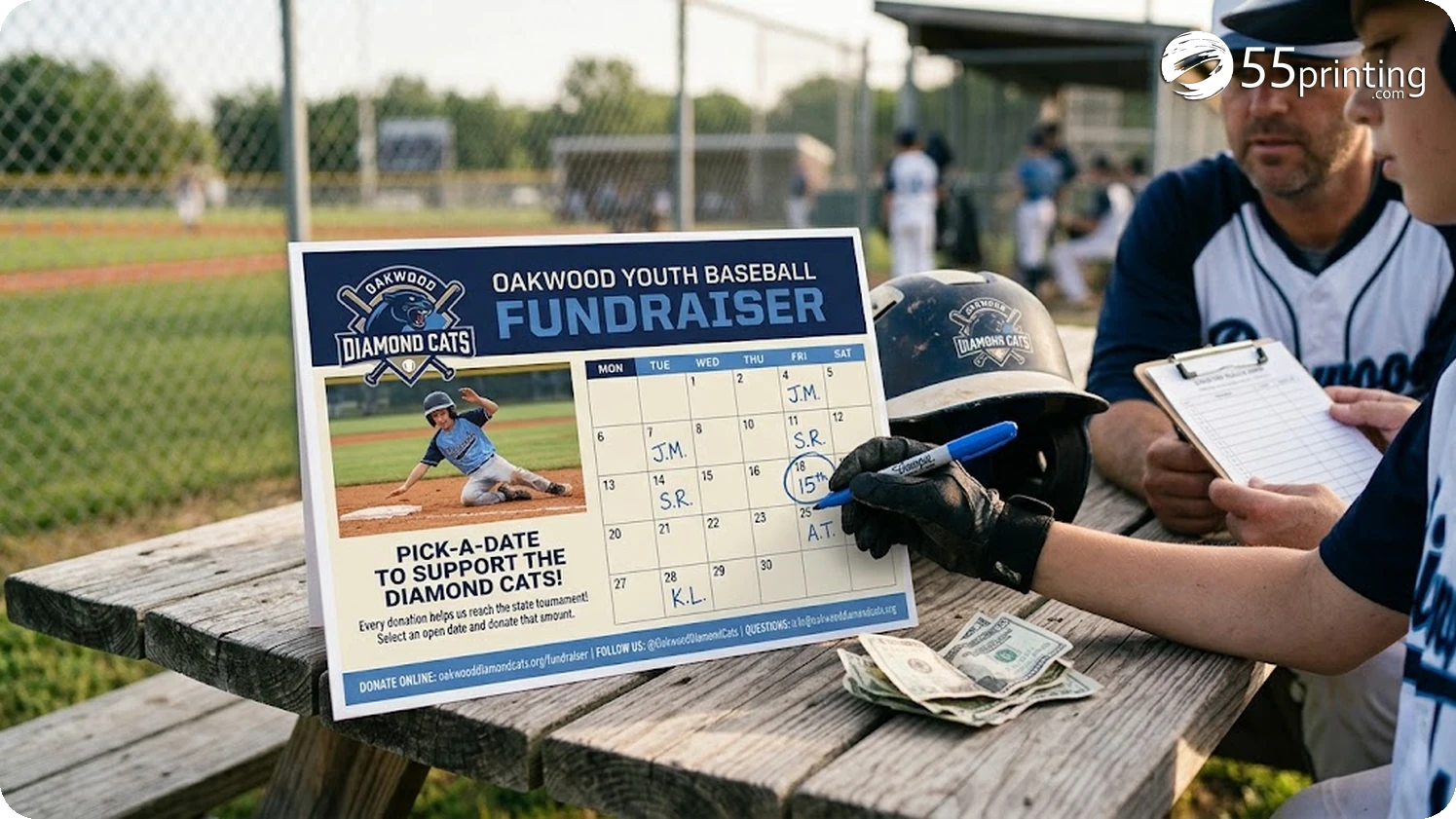
The working piece is a letter-size sheet: a bold month grid with date cells big enough for initials, the team name and cause at the top, the $496 target line, and a payment note telling donors how to pay. One printed sheet per seller is enough; groups running the shared version post the same file as an image and mark claimed dates between posts.
Printing options scale with the group. Hand each seller a color copy and a small run stays under $10 total, or print the grid on our 3.5 x 8.5 calendar cards at 500 for $75.80 when a booster club wants a polished keep-piece donors stick on the fridge. Groups that bundle the fundraiser grid into a full season calendar jump to the 12-page 6 x 9.5 booklet at $699.33 for 500 in print. The download below is a ready-to-fill letter grid for any month of 2027.
When to print
Pick-a-date runs are short, usually two to three weeks from launch to full grids, and printing is the fastest part. Color copies land same week; calendar cards and booklets take 4 to 9 business days from proof approval and payment to your door. For a January 2027 drive, have grids in players’ hands by early January and the team is counting money before February. The full order-by table lives in when to order 2027 calendars.
Download the pick-a-date grid template

Pick-a-date calendar fundraiser: common questions
How does a pick a date calendar fundraiser work?
Each seller gets a printed month grid. Donors pick any open date and donate that day number in dollars, then initial the cell they claimed. Fill every date and the calendar is done. There are no prizes or draws; the donation is the whole transaction.
What is the pick a date calendar fundraiser total?
A filled 31-day month raises exactly $496, because 1 + 2 + 3 through 31 sums to 496. A 30-day month raises $465 and February raises $406. Multiply by the number of sellers: 15 players filling January calendars raise $7,440.
Is a pick a date fundraiser a raffle or gambling?
No. Nobody wins a prize, so it is a donation drive, not a game of chance, and it sidesteps most raffle licensing questions that apply to lottery calendar fundraisers. Standard fundraising and school-activity rules still apply, so check with the treasurer or school office.
Which sports use pick a date fundraisers?
Softball, baseball, and soccer teams are the biggest users, and autocomplete reflects that. Cheer squads, dance studios, bands, and school clubs run the same mechanic with their own theme on the grid. The format works for any group with sellers who each know 20 to 30 potential donors.
What if a donor picks a high-numbered date?
That is by design: the donor chooses the amount. Someone comfortable giving $30 claims the 30th, someone giving $5 claims the 5th. The range of prices is why the format converts better than a flat ask. If low dates fill first, that is a good problem; it means the calendar is working.
Can donors claim more than one date?
Yes, and many groups encourage it as the double pick: claim two dates, pay both amounts, or sponsor a whole week row for a flat sum. A local business buying a full week for $100 is the most common big-ticket version. Just write initials in every claimed cell so dates never sell twice.
What do we need to print for a pick a date fundraiser?
One letter-size grid per seller is the whole kit: month grid, team name, the dollar total, and a payment line. Color copies keep a small run under $10, our 3.5 x 8.5 calendar cards run $75.80 for 500 for a polished keep-piece, and groups bundling the grid into a season booklet pay $699.33 in print for 500 copies.
How long should the fundraiser run?
Two to three weeks is the sweet spot: long enough for every seller to work their network, short enough to keep energy high. Launch on a team meeting night, set a grid-complete deadline, and close it when calendars are full or the deadline hits.
Calendar cards run $75.80 for 500 on the postcard form, and the 12-page booklet runs $699.33 for 500 in print, $757.16 packed with Ground shipping shown before checkout.