


LAST UPDATE: 10 / 21 / 2026
You can sell an original calendar on Etsy when its design and production arrangement meet the current seller rules. Compare complete project costs before choosing bulk or print on demand. A dated 1,000-copy quote for our 16-page booklet is $1,019.05 for printing, about $1.02 each; that is not the cost of fulfilling an Etsy sale.
Every October the same pattern repeats on Etsy: calendar listings surge, sellers with stock ship fast and collect reviews, and sellers who started researching in November watch the season pass. Calendars are one of the cleanest seasonal products on the platform because demand is concentrated, buyers already know what they want, and the unit economics reward anyone who prints ahead instead of printing per order. This page covers the honest margin math between bulk printing and print on demand, the listing mechanics, and the shipping setup that keeps calendars arriving flat.
Can you sell calendars on Etsy? Start with an eligible design
A calendar listing needs an eligible creative product, accurate photographs, and a clear description. Review Etsy’s Creativity Standards for your design and any production partner. An original botanical illustration, local photograph, or pet portrait can give a calendar a clear audience, but no theme guarantees demand. Check your rights to every photograph, font, and illustration before you offer it for sale.
For a US Etsy Payments example with a $25 order total and no separately charged shipping or tax, the $0.20 listing charge, 6.5% transaction fee, and 3% plus $0.25 processing charge total about $2.83. Check the official fee policy and country-specific processing schedule. Advertising and other applicable charges can increase that amount.
The margin math: compare complete costs
Use current quotes for the same calendar size, page count, paper, binding, and destination. Our October 21, 2026 print-only quotes below are for the 16-page 6 x 9.5 booklet with the selected gloss text and cover papers. A print-on-demand supplier must quote its own product and shipping; this article does not substitute an assumed market price for that quote.
| Run | Print total | Print each | Stock commitment |
|---|---|---|---|
| 500 | $841.94 | $1.68 | 500 copies |
| 1,000 | $1,019.05 | $1.02 | 1,000 copies |
| 2,500 | $1,709.68 | $0.68 | 2,500 copies |
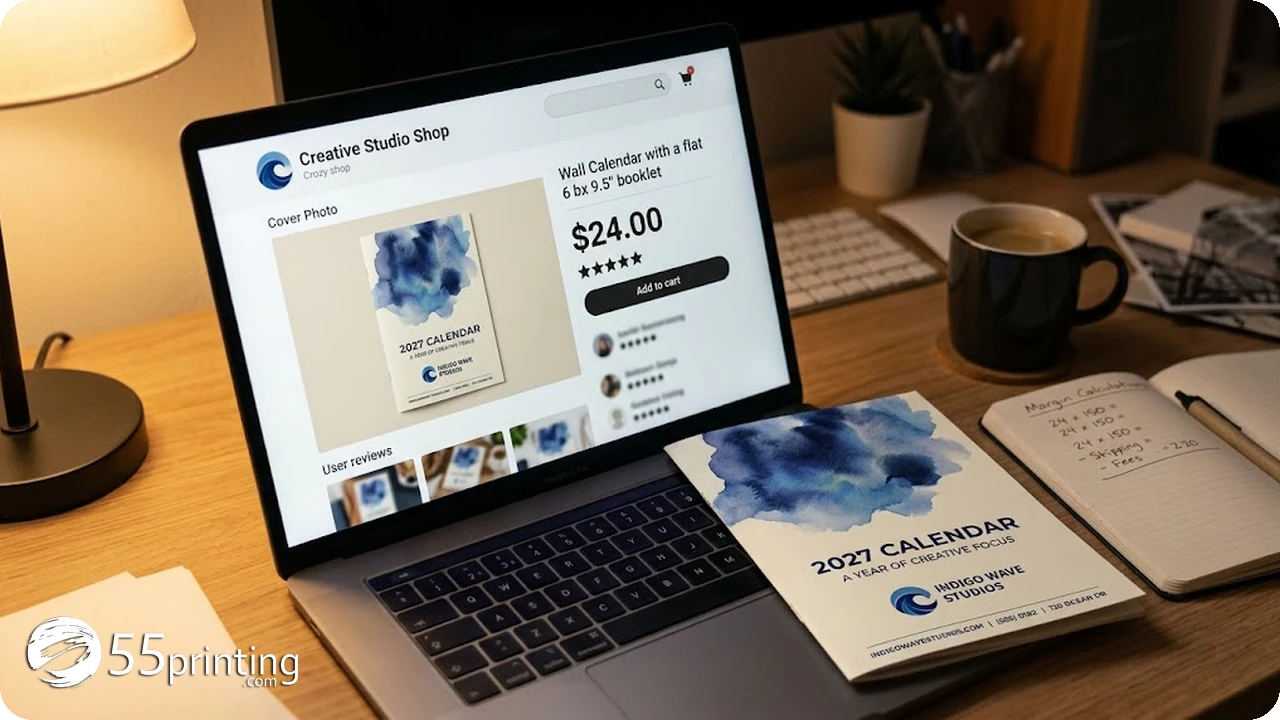
For an explicitly hypothetical $25 sale, subtracting $2.83 in the stated platform fees, $4 in assumed packing and postage, and $1.02 in printing leaves $17.15 before inbound shipping, design, labor, advertising, returns, taxes, and unsold stock. It is a partial contribution calculation, not net profit. Replace the $4 assumption with the packed sample’s actual quote.
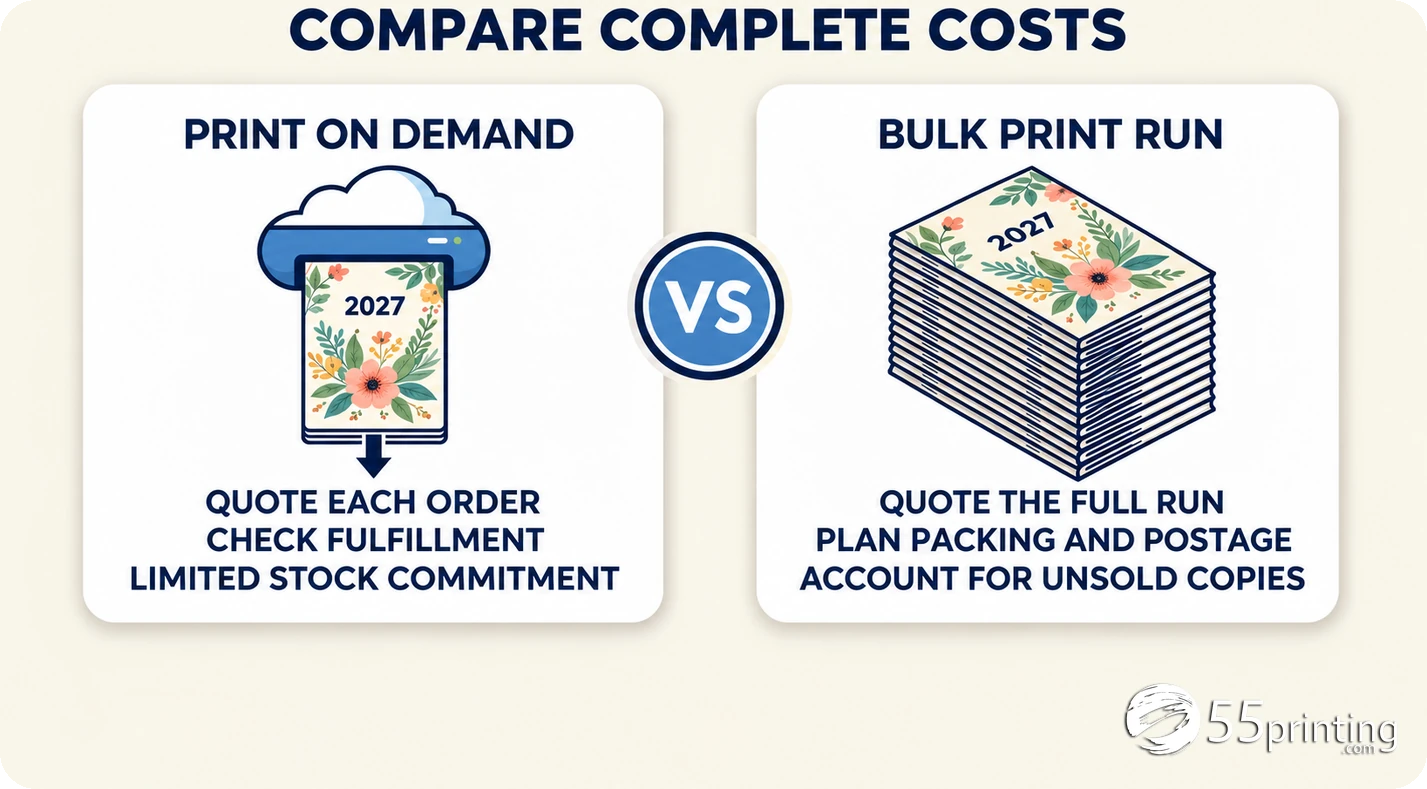
Compare project totals at the number of copies you reasonably expect to sell. Bulk requires paying for the entire run, including unsold copies; print on demand usually ties production to individual orders. There is no universal 100-copy or 200-copy crossover. The comparison worksheet records your inputs, while make your own calendar to sell covers the design workflow.
Digital versus physical: two different products
A printable file and a finished booklet solve different needs. The digital buyer supplies a printer and paper; the physical buyer expects the advertised size, stock, binding, and delivery. Show precisely which files or pages are included, and make the product type clear in the first listing image. Use your own shop research and a small demand test to set a selling price rather than treating a broad price range as a verified market average.
If you sell both versions, keep the listings and fulfillment instructions distinct. A digital order should never promise shipment of a printed calendar, and a physical order should state its processing time and delivery method. Test the downloadable file yourself and photograph a complete physical sample before taking either listing live.
Make the listing describe the real calendar
Show the cover, a complete month page, the binding, and a size reference. A view of all twelve months helps buyers understand the artwork included. A kitchen or office photograph can demonstrate placement, but retain a clear product view so styling does not hide the actual calendar. Use a descriptive title with the year, format, and subject; a title formula alone cannot guarantee search ranking.
Complete the current listing fields and use relevant tags that describe the product. Promise a processing time your packing workflow can meet, including peak weeks. Check the listing from a buyer’s view before launch: dimensions, page count, start month, shipped contents, personalization limits, and the distinction between processing and carrier transit should all be clear.
Test shipping before setting the price
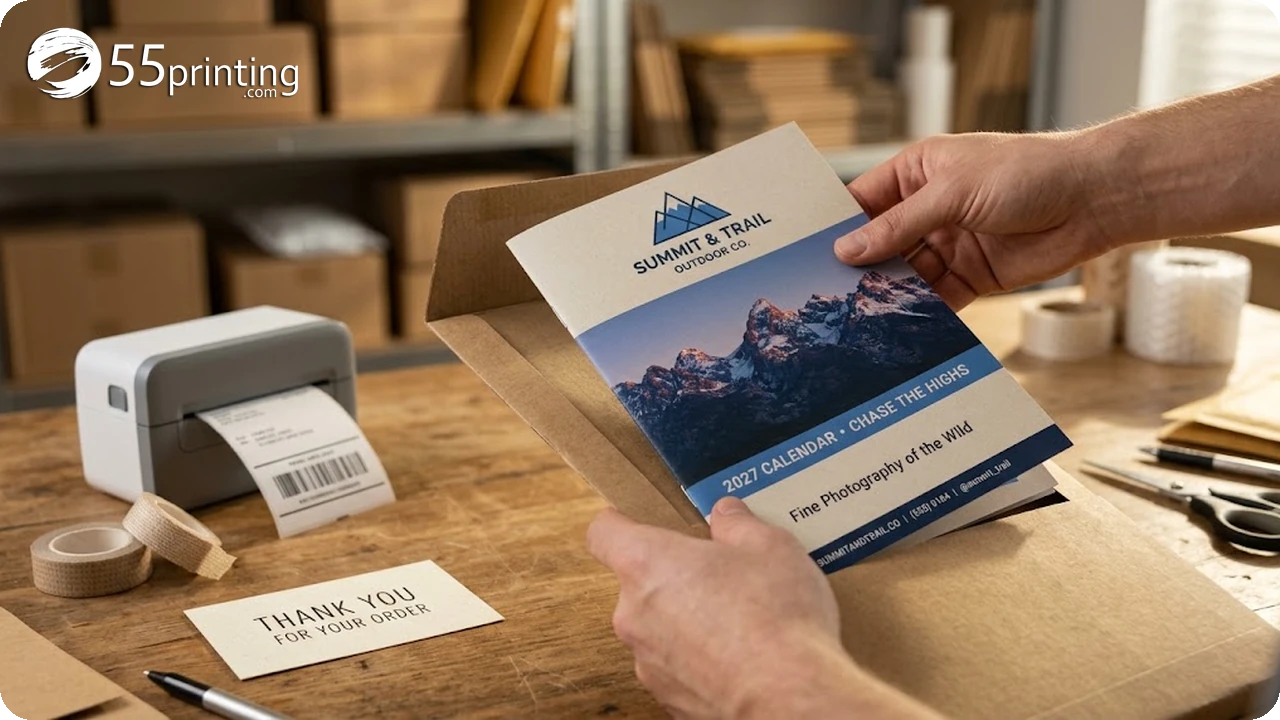
Pack a finished sample in the proposed sleeve and rigid mailer, then weigh and measure the complete package. Obtain a current carrier quote for representative destinations and check whether tracking, insurance, or other service features are included. A print-only cost does not include mailing each Etsy order.
Test the mailer for corner protection and movement inside the package. Keep the calendar flat and add suitable protection when needed. Photograph the packing method for your own workflow, and budget materials, labor, replacements, and returns separately. Use the verified package weight and dimensions in the listing instead of a universal postage estimate.
Plan the selling season around your own evidence
Choose a listing date from your audience, previous orders, and the time needed to photograph a finished sample. Work backward through artwork approval, proof corrections, current production, inbound transit, and packing. Recheck the live delivery estimate for your papers and destination rather than treating a four-to-nine-day range as a promise.
Set a last order date from the actual delivery method and leave room for delays. Review stock and sell-through regularly as the year changes; a lower unit print price does not justify a larger unsold pile. Explain any later-year calendar clearly rather than assuming every copy loses all value on a particular January date.
Downloads for Etsy calendar sellers
 PDF, 1 pageEtsy Calendar Listing ChecklistTitle formula, photo list, tag prompts, pricing field, and launch-day checks. Fill it in before the listing goes live.Download PDF
 PDF, 1 pagePOD vs Bulk Margin SheetYour sale price, our unit costs, POD rates, and fees in one grid. Find your real profit per calendar.Download PDF
Selling calendars on Etsy: common questions
Can you sell calendars on Etsy?
Yes, provided the listing and production arrangement meet Etsy’s current seller rules. Build the calendar around artwork you may sell, describe its actual size and binding, and disclose any production partner where required. Start with one complete sample so your listing photos, promised contents, and shipped calendar all describe the same product.
Do digital calendars sell well on Etsy?
Digital and printed calendars serve different buyers, and sales vary by design, audience, price, and listing quality. A digital file removes physical fulfillment but still needs testing and clear instructions. A printed version adds production, packaging, postage, and inventory costs. Use your own demand test rather than assuming either format sells better across Etsy.
Is it cheaper to bulk print or use print on demand?
Compare the total cost at your expected sales volume, using current quotes for matching products. Bulk printing can lower the cost per copy, but you pay for the full run and retain unsold stock. Print on demand can limit that inventory commitment. Include platform fees, delivery, packaging, labor, and returns before calling either option more profitable.
How much does Etsy charge to sell a calendar?
For a US Etsy Payments example, the published fees include a $0.20 listing charge, a 6.5% transaction fee, and payment processing of 3% plus $0.25. On a $25 order with no separate shipping or tax, that is about $2.83 before advertising or other applicable fees. Check your account’s country-specific schedule.
What kind of calendars sell best on Etsy?
Choose a theme for a specific audience you can reach, such as local scenery, original botanical illustrations, or a documented pet-photo project. These are design directions, not verified best-seller rankings. Compare actual inquiries and test orders before buying 500 copies; an attractive theme alone does not establish demand or guarantee profitable sales.
How do I ship wall calendars without damage?
Rigid flat mailers or stay-flat envelopes, never a bubble mailer alone. Sleeve the calendar, add a stiff card if the mailer is oversized, and price shipping off a real scale weighing of the packed piece, roughly $4 to $6 Ground Advantage for a 6 x 9.5 booklet.
When should I list a 2027 calendar on Etsy?
Work backward from your own sales and shipping cutoff. A September launch is a planning option, not an Etsy requirement or a guaranteed ranking advantage. For 2027 stock, allow time for a complete sample, proof approval, production, inbound shipping, and packing. Display a dispatch estimate you can support with stock already available.
How many calendars should I print for a first run?
Match the print run to proven demand, not hope. If a POD or small-batch test sold 50 in a month, a 500 run is justified; if the design is untested, stay on POD until the listing shows real conversion. The margin sheet download runs the break-even math for your numbers.
The 16-page booklet runs $841.94 for 500 and $1,019.05 for 1,000, with Ground shipping shown before checkout.