

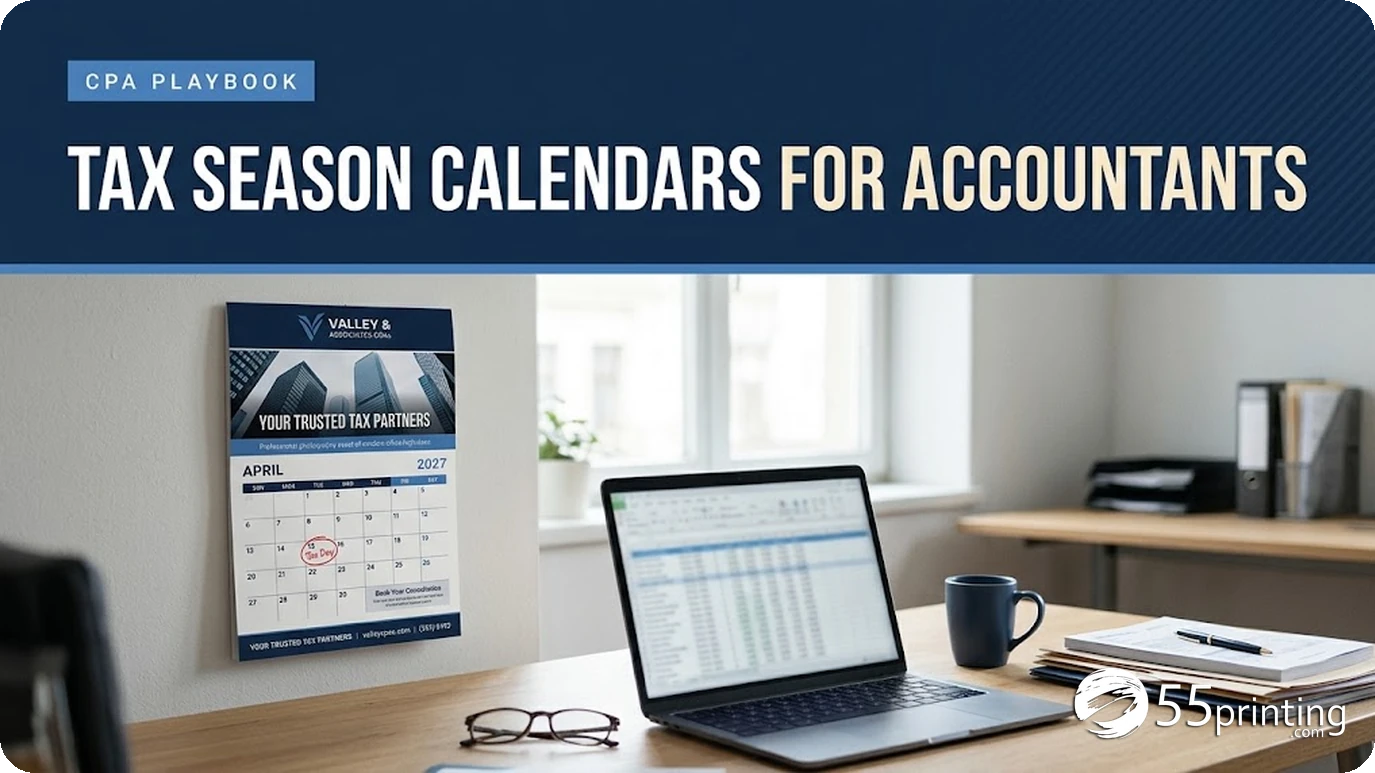
Build separate reminders for the tax year, filer type and applicable jurisdiction. Record the source and verification date beside each intended entry in the worksheet. Confirm the order timeline from your actual distribution date and keep print cost separate from packaging and mailing. An example firm’s marked day is a layout placeholder.
Accounting has a built-in product advantage most industries would kill for: a calendar your clients actually need. Every business owner knows they have deadlines; almost none can name them. A printed calendar carrying professionally verified reminders, your firm’s name, and a booking line does the reminder work your front desk would otherwise do by phone, twelve months a year. This page is the CPA playbook: which dates to print, how the firm strip works, and when to drop.
Why the calendar beats every other client gift
Mugs get lost, pens dry out, and holiday cards are recycled by January 10. A wall calendar earns its spot because it answers a real client question every single day: “when is that due?” For a tax practice, that question is the product. The client who checks the wall calendar in February sees your firm name and the March 15 S-corp deadline together; that pairing is the whole pitch, repeated daily for a year.
The economics match the story: at 500 copies the 16-page booklet runs about $1.68 each, cheaper than a greeting card and useful for twelve months. The January drop also lands when inboxes are thin and clients are thinking about the year ahead, not holiday noise.
Verify the 2027 dates before printing
Ask the practice to select the obligations relevant to the intended clients, then verify each date against current official guidance. Individual, entity, payroll, federal, and state obligations differ. The IRS filing-date guidance also explains why weekends, holidays, extensions, and special circumstances require care. A familiar date from a previous year is not sufficient proof for the new artwork.
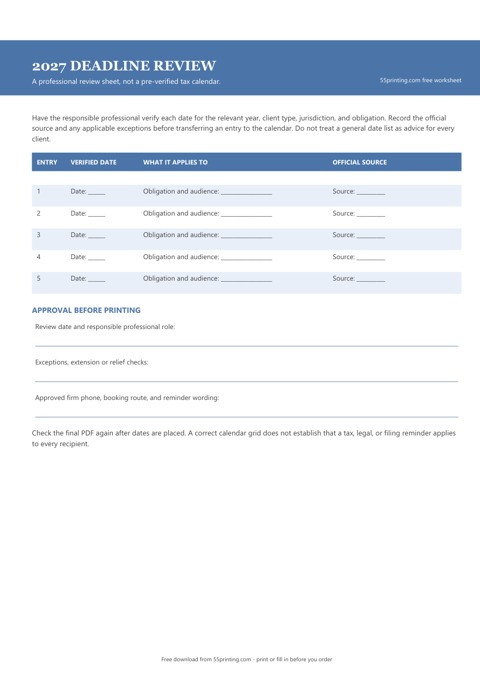
The downloadable deadline review sheet has blank entries for the date, audience, obligation, and official source. It is deliberately a verification worksheet rather than a pre-approved list of seven federal deadlines. Record who approved the entries and when, then check their placement again in the final PDF. Use the firm’s booking deadline as a separate reminder, clearly labeled so a client cannot mistake it for a legal filing date.
The firm strip: the offer on every page
The strip across the bottom of each month does the commercial work: firm name, phone, and a booking line like “Book your tax appointment by March 1.” It sits where the eye lands on every glance at the calendar, which is why it outperforms a back-cover ad panel. Keep it to three elements; a strip that tries to list services stops being a reminder.
A small QR or short URL to the booking page fits the strip cleanly and converts the wall into a click. The free design request team can drop the strip onto your artwork if your designer does not want to lay it out.
Drop timing: early January, not Thanksgiving
For the detailed carrier and production math, the Plan the calendar order date covers the cutoff window, and the Plan the calendar order date covers what to do if November slipped.
Who gets one, and how many to print
Prioritize the list: active business clients and high-value personal returns first (they are the retention and referral base), then prospects from last year’s inquiries, then partners who send you referrals. A 500-run covers a mid-size practice’s A-list with buffer for walk-ins; 1,000 covers a firm that mails the whole client file.
Do not cheapen the piece by narrowing the list to only top clients; the referral value lives in the clients who recommend you, beyond the ones who pay the most.
Mailing it: the envelope question
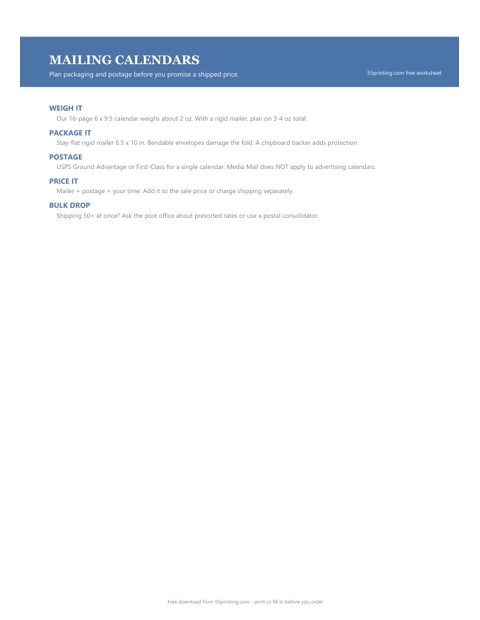
A 6 x 9.5 saddle-stitch booklet mails flat in a 6.5 x 9.5 envelope; a 500-piece Ground-shipped run is the standard build. The mailing worksheet in the downloads does the postage-plus-print math so the drop lands in the right week. Mailing beats handout for reach but not for warmth: the counter stack in the lobby is still the highest-conversion handoff because the client picks it up while they are thinking about you.
Downloads for the CPA build
Use the calendar as a reminder approved by your firm
Review the selected format and artwork on the published product page. Use its current quote for the job and ZIP.
Tax-season calendars for accountants: common questions
What dates should an accounting firm’s calendar print?
Use dates verified and approved by the practice for the relevant tax year and client type. Federal, state, payroll, entity, and individual deadlines can differ, and extensions or relief can change them. Have the responsible accountant check every entry against current official guidance before proof approval; a generic seven-date list is not sufficient for every client.
When should a CPA office order client calendars?
Work backward from when the calendars should reach clients. Leave time to confirm the dates with the accountant who owns the calendar, approve the paper proof, and check the production and delivery estimate for your ZIP code. If the office will mail copies in waves, count the first mailing as the deadline for the whole print run.
What goes on the firm strip?
Keep the repeated contact strip focused: the verified firm name, one phone or booking route, and a short relevant reminder. Test any QR destination on a printed sample. Check the strip on all twelve months, because a changed phone number or clipped URL repeats through the entire run and cannot be corrected after printing.
How many calendars does a practice need?
Count the clients you actually intend to reach, then add a documented allowance for reception, referral partners, and replacements. The booklet minimum is 500, so compare that commitment with the real list before ordering. A 1,000-copy run is not justified simply because its per-copy print price is lower; distribution and storage still cost money.
Is a calendar a better client gift than a mug or pen?
A calendar may suit clients who need visible planning reminders, while another gift may better fit a different audience. Compare usefulness, complete cost, and the response you want rather than assuming daily use for a year. Ask a small client group about the format, and keep tax advice separate from promotional wording on the printed piece.
Should the calendar lead with tax dates or firm branding?
Make the date grid and the practice-approved reminders easy to read, with the firm identification in a consistent supporting position. Do not let a large logo crowd an important date or qualification. Ask the accountant to approve the final PDF, including the tax year, scope of each reminder, and contact route for client-specific questions.
What does a 500-run cost?
The October 21 print-only quote for 500 copies of the 16-page 6 x 9.5 booklet is $841.94, approximately $1.68 per copy. Shipping is additional and varies with the destination and rate check. A flat calendar card has a different specification and price; compare its live quote rather than treating it as the same product.
Does the deadline overlay work for non-CPA businesses?
The blank planning structure can be adapted, but the accounting dates should not be copied without review. A payroll service, bookkeeper, or other adviser may serve different obligations and client types. Replace the firm details, identify the relevant year, and have the responsible professional approve each deadline and qualification before the file is printed.
500 sixteen-page booklets run $841.94, about $1.68 each. January drop, October payoff.