


Put your in-hand date on the planner and work backward through distribution, carrier transit, production and proof approval. Ask for the current estimate by ZIP. An earlier artwork decision provides room for revisions. A month name on a planning chart cannot guarantee a delivery window, capacity or rush price.
Company calendar orders follow the same rhythm every year, and the businesses that land on time are the ones that understand it. The short version: if your calendars should be on walls in January, the order goes in during October or November, not December. This page maps the five procurement windows so the timing is a decision, not a scramble.
The annual rhythm
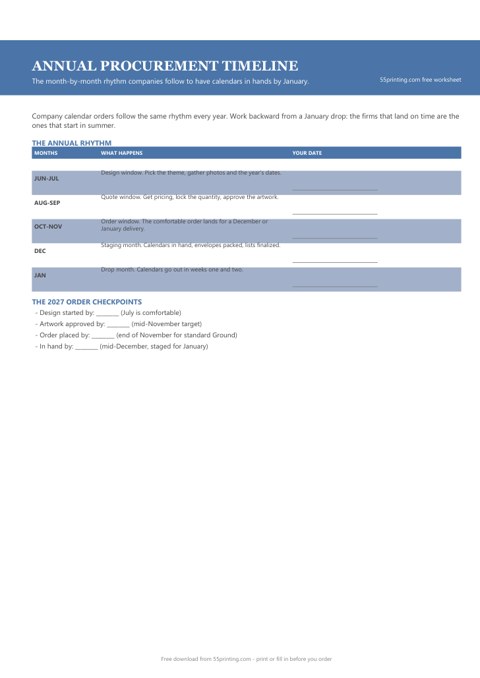
Work backward from the January drop. A January wall-hang needs calendars in hand by mid-December, which means the order placed by late November for standard production and Ground shipping. That order needs approved artwork, which needs a design phase in summer or early fall. The rhythm repeats every year: the companies that order in October-November are the ones that treated July as design season.
The procurement timeline worksheet in the downloads turns this into a fill-in sheet with a column for your real dates, so the rhythm becomes a calendar on the wall instead of a memory.
The five windows, month by month
June-July is the design window: pick the theme, gather photos, lock the year’s dates. August-September is the quote window: get pricing, set the quantity, approve the artwork. October-November is the order window: the comfortable order lands for December-January delivery on standard turnaround. December is the staging month: calendars in hand, envelopes packed, mailing lists finalized. January is the drop month: the piece goes out in weeks one and two.
The late-order trap
The December escape path exists: the Plan the calendar order date covers the card fallback and the split run when the window is truly gone.
How the window shifts by company size
| Company | Order window | Why |
|---|---|---|
| Solo or small shop | November | Small run, fast approval, flexible drop |
| Mid-size firm | October to mid-November | Internal sign-off adds weeks |
| Large company | September to October | Procurement, legal, and multi-site delivery |
| Agency or printer | Year-round | Client deadlines vary; the rhythm is theirs |
The pattern: the bigger the approval chain, the earlier the window. A solo owner decides in a day; a corporate marketing team needs the budget approved a quarter ahead.
The 2027 checkpoints
If you are reading this in November, the order window is now; if it is December, the card fallback and the Explore calendar design ideas still make the drop work.
Downloads for the procurement year
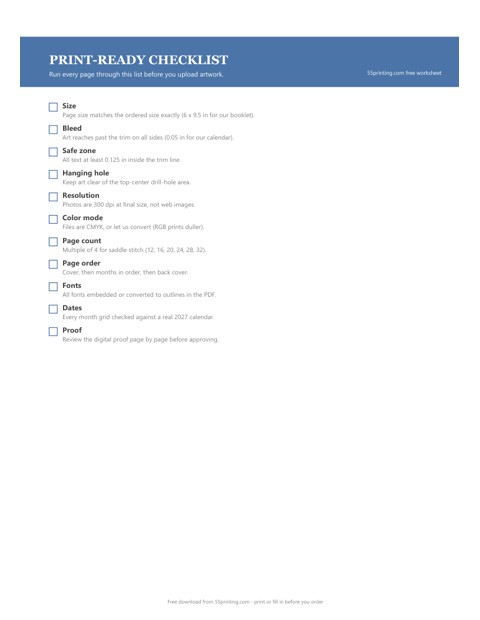
Work backward from the actual January handoff
Review the selected format and artwork on the published product page. Use its current quote for the job and ZIP.
When companies order calendars: common questions
When do most companies order calendars?
There is no measured ordering month shared by every company. Plan backward from your own distribution date, allowing time for artwork, internal approvals, proof review, production, and destination shipping. An autumn start may suit a year-end client gift, while an event or financial-year calendar may follow a completely different procurement schedule.
Is November too late to order company calendars?
November can still suit some projects, but the exact handout date, specification, and destination decide feasibility. Check that the artwork and recipient list are ready, then obtain current production and shipping estimates. Leave room for proof corrections and holiday closures. Do not announce a December arrival merely because the order was placed in November.
When should the calendar design start?
Begin when you can gather the twelve month images, verified business details, permissions, and any dates the calendar must show. Schedule a separate internal content review before the print proof. A simple logo change may need less work than a new photo project, so set the design milestone from the actual tasks rather than a fixed month.
Do big companies order earlier?
A larger organization may need extra time for purchasing, brand review, multiple locations, and approval authority, but size alone does not establish its ordering pattern. List those steps before selecting the print date. Confirm who can approve the final PDF and quantity so a finished design does not wait unnecessarily for an internal decision.
What happens if we order in December?
Check whether the remaining proof, production, and transit stages fit your intended use date. December holidays and your own office closures can reduce the receiving window. If the estimate is too late, revise the distribution plan or request an appropriate alternative. A December order does not automatically become a first-week January delivery.
Should the order wait for January planning?
Wait only for information that genuinely needs the January planning decision. If that affects the offer, dates, or quantity, avoid printing assumptions that may become wrong. You can prepare photographs, permissions, and a draft layout earlier. Once the content is approved, request the current print and shipping estimates for the final specification.
How long does calendar production take?
The booklet’s online turnaround is Regular Production. Confirm the current production estimate for your selected papers, then add the shipping estimate for the destination. The clock follows required proof approval and payment, not the first design conversation. Keep your internal review time separate when calculating how early the project needs to start.
Is there a best month to order?
The best ordering month is the one that leaves enough time before your own distribution date without locking in unverified content. Compare the current production estimate, transit, artwork workload, and approval process. Record those assumptions in the planner, then recheck them before ordering instead of treating a general autumn recommendation as a guaranteed deadline.
The 16-page booklet runs $841.94 for 500; a November order lands mid-December on standard Ground.