

LAST UPDATE: 10 / 06 / 2026
A school calendar fundraiser sells printed calendars filled with student artwork, class photos, or school memories, usually for $10 to $20 each. A school ordering 500 16-page booklets at $841.94 and selling at $15 grosses $7,500, clearing about $6,658 after print cost. The art contest that fills the pages doubles as the marketing.
Every school needs a fundraiser that parents actually want to buy, and a calendar made of student art is the rare product that sells itself: grandparents buy it for the fridge, families buy one per household, and the artwork makes it a keepsake instead of a catalog item. The version that works best runs a school-wide art contest where twelve winning pieces become the twelve months. This page covers the contest engine, the real sales math, how to collect art and orders, and the print specs.
The art contest that fills the calendar
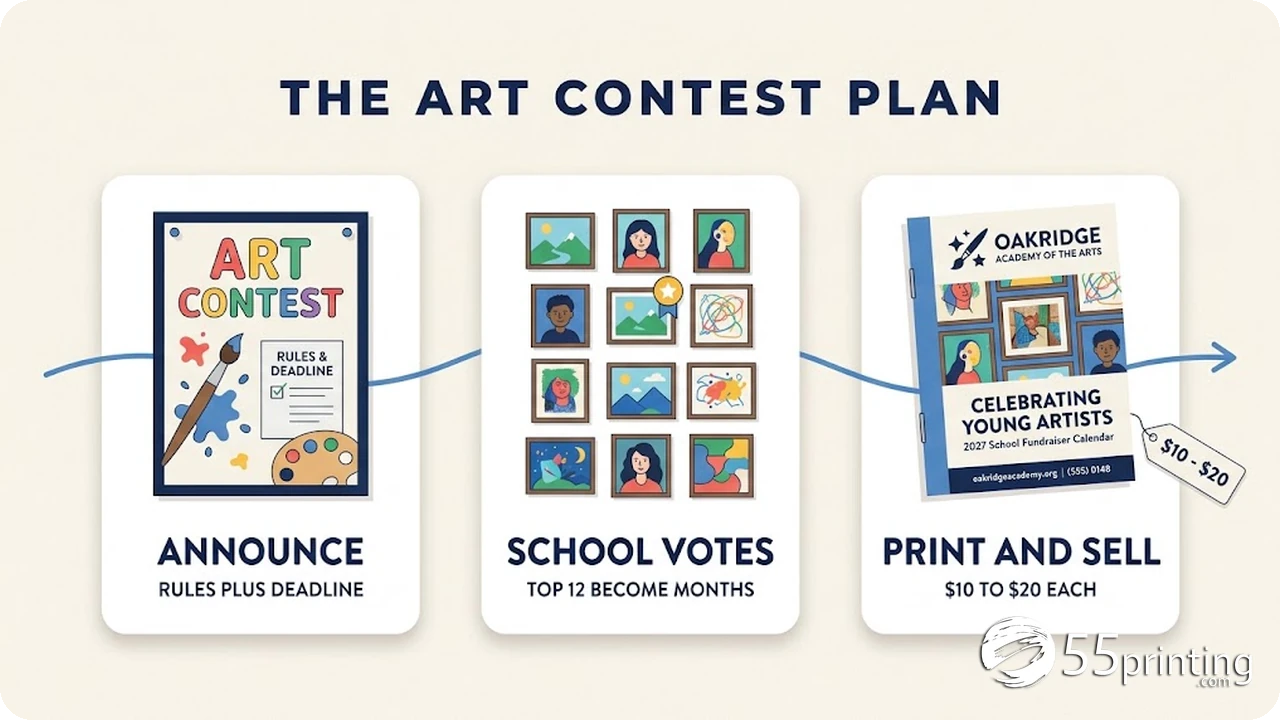
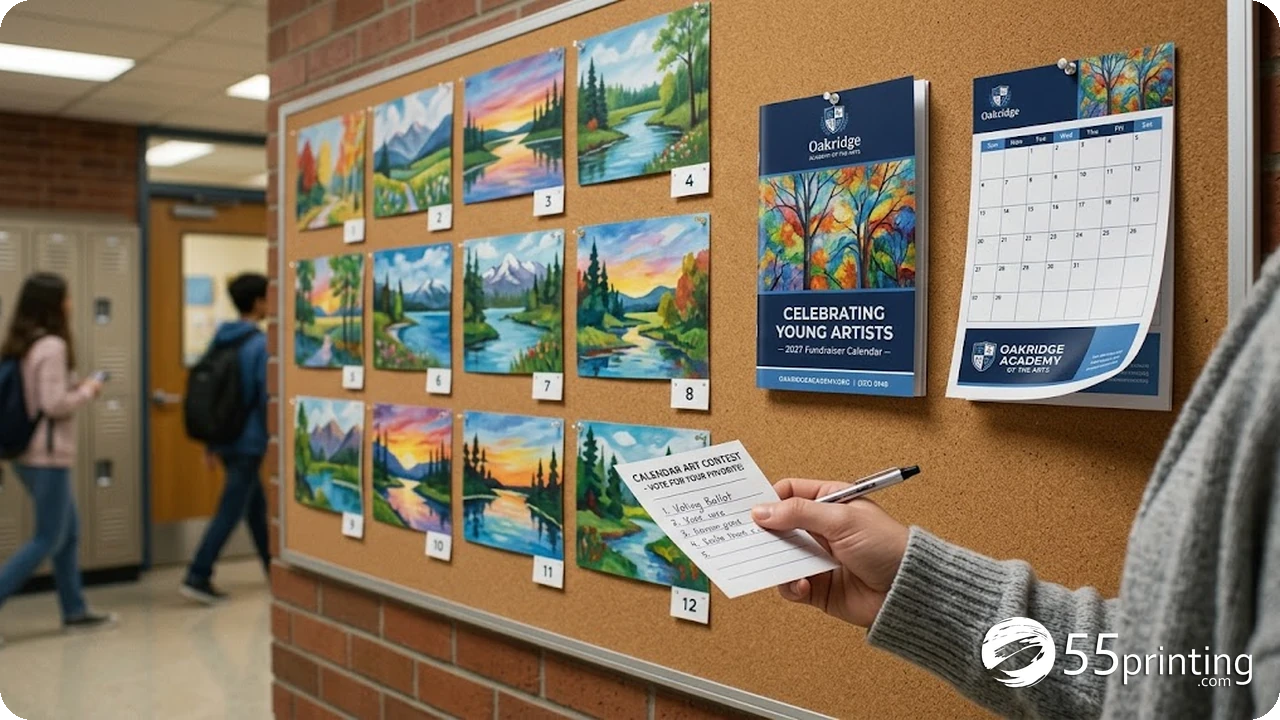
The mechanic is simple: announce a contest, collect one landscape-format artwork per student, let the school vote, and assign the top 12 pieces to months. The contest does three jobs at once. It generates the calendar’s content for free, it gets every family emotionally invested before the order form exists, and it creates a natural announcement moment when winners are named, which is when pre-orders open.
Two rules make the contest run clean. First, require landscape art, wider than tall, because every calendar page is landscape; portrait art gets cropped or excluded and that conversation is painful. Second, number the entries instead of naming them during the vote, so the panel picks art instead of picking their friends’ kids. The download below is a one-page kit with the rules sheet, spec box, and a 12-row submission log built for exactly this.
The sales math on a school run
Calendar fundraisers work because the per-unit cost drops hard at school-sized quantities while the sell price stays consumer-level. The standard school piece is the 6 x 9.5 saddle-stitched booklet, 16 pages covering the cover, twelve months, and a back page. At 500 copies that booklet runs $841.94 in print, or about $1.68 each. Sold at $15, a single grade level clears over $6,600.
| Quantity | Print cost | Gross at $15 | Net to the school |
|---|---|---|---|
| 500 calendars | $841.94 | $7,500 | about $6,658 |
| 1,000 calendars | $998.67 | $15,000 | about $14,001 |
| 2,500 calendars | $1,675.49 | $37,500 | about $35,825 |
The leverage is sell-through, not price. A school of 400 students that sells one calendar to half its families moves 200 units; add grandparents, staff, and the neighborhood businesses parents work at, and 500 is a realistic floor for a single school. Order to the pre-order count plus a 15 to 20 percent buffer for at-event sales, not to a hope.
Collecting art and orders without chaos
Art collection works best through one channel: homeroom teachers or the art teacher, not loose submissions to the office. Set a three-week window, give each entry a number on receipt, and store originals flat. Any 3-D or oversized pieces get photographed or scanned; the file you send to print is what matters, so a good phone photo in daylight beats a creased original.
Order collection mirrors the contest. Send the order form home the day winners are announced, while the excitement is fresh, and collect for exactly two weeks. Most PTAs run a paper form plus an online payment option, and the winning students’ families order first and loudest. A second announcement at pickup, “last week to order the calendar,” reliably doubles the final tally.
Selling sponsor spots to local businesses
Schools with a business community nearby can cover most or all of the print bill before a single family buys. The standard offer is a sponsor strip along the bottom of a month page or a spot on the back cover: $100 to $250 per month for a local business name, logo, and one line. Twelve sponsors at $150 is $1,800, which more than covers the 500-copy print run, and every calendar sold after that is pure margin.
The pitch that works: this calendar hangs on 500 local refrigerators for 12 months. That is the same audience a business would pay to reach with postcards, and the calendar stays up all year. Our sponsor sign-up worksheet has the tracking table for who promised what.
Printing specs that survive a school year
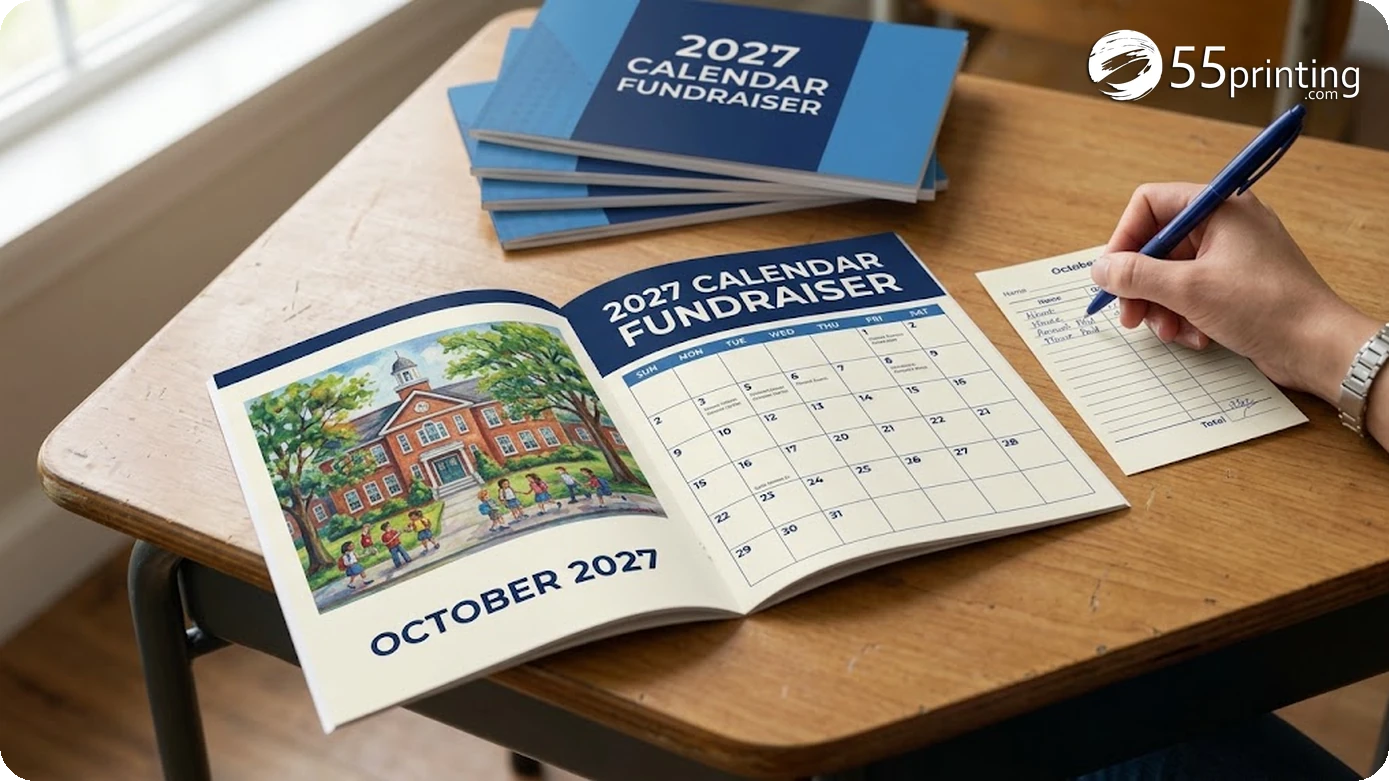
The standard school calendar is our 6 x 9.5 saddle-stitched booklet with a hole for hanging. The interior grid pages should be a paper that takes pen, since families write birthdays and reminders on calendars; keep heavy gloss for the cover and art pages. Twelve winning artworks map to twelve months, the cover carries the school name and year, and a credits line on each page names the artist by grade, which is the detail that makes families keep it.
Scans and photos of the art need to be big enough to print: 300 DPI at final size is the target, and a clear phone photo in window light usually gets there. The print-ready checklist in the downloads covers bleed and safe zone. If the school wants a professional layout without a volunteer designer, our free calendar design request builds the file from the collected art.
When to order for a school calendar
Calendars print in 4 to 9 business days from proof approval and payment to your door, but the school timeline has three earlier clocks: the contest needs three weeks, order collection needs two, and principal sign-off needs whatever it needs. Schools selling a 2027 calendar should run the contest in late October or early November, close orders by mid-November, and have boxes in hand for early-December send-home. The full deadline table lives in when to order 2027 calendars.
Downloads for the school fundraiser
 PDF, 16 pagesSchool Calendar Template 2027Complete 6 x 9.5 booklet: cover, 12 month grids with seasonal school art, holidays marked. Print-ready layout to copy.Download PDF
 PDF, 1 pageStudent Art Contest Kit4-step contest plan, art spec rules for students, and a 12-row submission log with release checkboxes.Download PDF
School calendar fundraiser: common questions
How does a school calendar fundraiser work?
Students create artwork, the school picks 12 winning pieces for the months, and families pre-order the printed calendar at $10 to $20 each. The school orders to the pre-order count, keeps the margin over print cost, and sends calendars home before winter break.
How much money can a school calendar fundraiser make?
At 500 calendars sold for $15, the school grosses $7,500 and nets about $6,658 after the $841.94 print run. At 1,000 sold, the net climbs to about $14,001. Sponsor spots sold to local businesses can cover the entire print bill before families buy a single copy.
How do we collect the student artwork?
Run it as a contest through homerooms or the art teacher: one landscape piece per student, a three-week window, entries numbered not named for the vote. The free contest kit on this page includes the rules sheet and a submission log that tracks artist, grade, month, and release.
Do we need permission slips to print student art?
Yes. Every printed piece needs a signed art or photo release from the parent or guardian, and most schools keep student last names off the pages. The kit’s log has a release checkbox per entry, and a free release form is linked in the article.
What size should the school calendar be?
The standard is the 6 x 9.5 saddle-stitched booklet with a hanging hole: big enough for a full art page and a writable month grid, small enough that 500 copies of the 16-page version cost $841.94 in print. Schools wanting a bigger keepsake can scale up; the art spec stays landscape either way.
How long does printing take?
Calendars print in 4 to 9 business days after proof approval and payment. The real lead time is the contest, voting, and order collection, so plan roughly eight weeks from announcing the contest to boxes in hand. The deadline table in when to order 2027 calendars covers the exact order-by dates.
Should we sell calendars or use pick-a-date instead?
They solve different problems. Calendar sales raise bigger totals and produce a keepsake, but take weeks and artwork. Pick-a-date needs only a printed grid and finishes in two weeks, raising up to $496 per filled calendar per seller. Many schools run pick-a-date in fall and the art calendar for winter. See the pick-a-date guide for the comparison.
Can a PTA or PTO run this, or does the school have to?
PTAs and PTOs run most of them. The parent group organizes the contest and the money, with the school’s blessing and usually the art teacher’s help. Get the principal’s sign-off first because the calendar carries the school’s name, then the parent group owns execution end to end.
The 16-page booklet runs $841.94 for 500, about $1.68 each, with Ground shipping shown before checkout.