

Low-Resolution Logos: Redraw, Replace, or Accept?
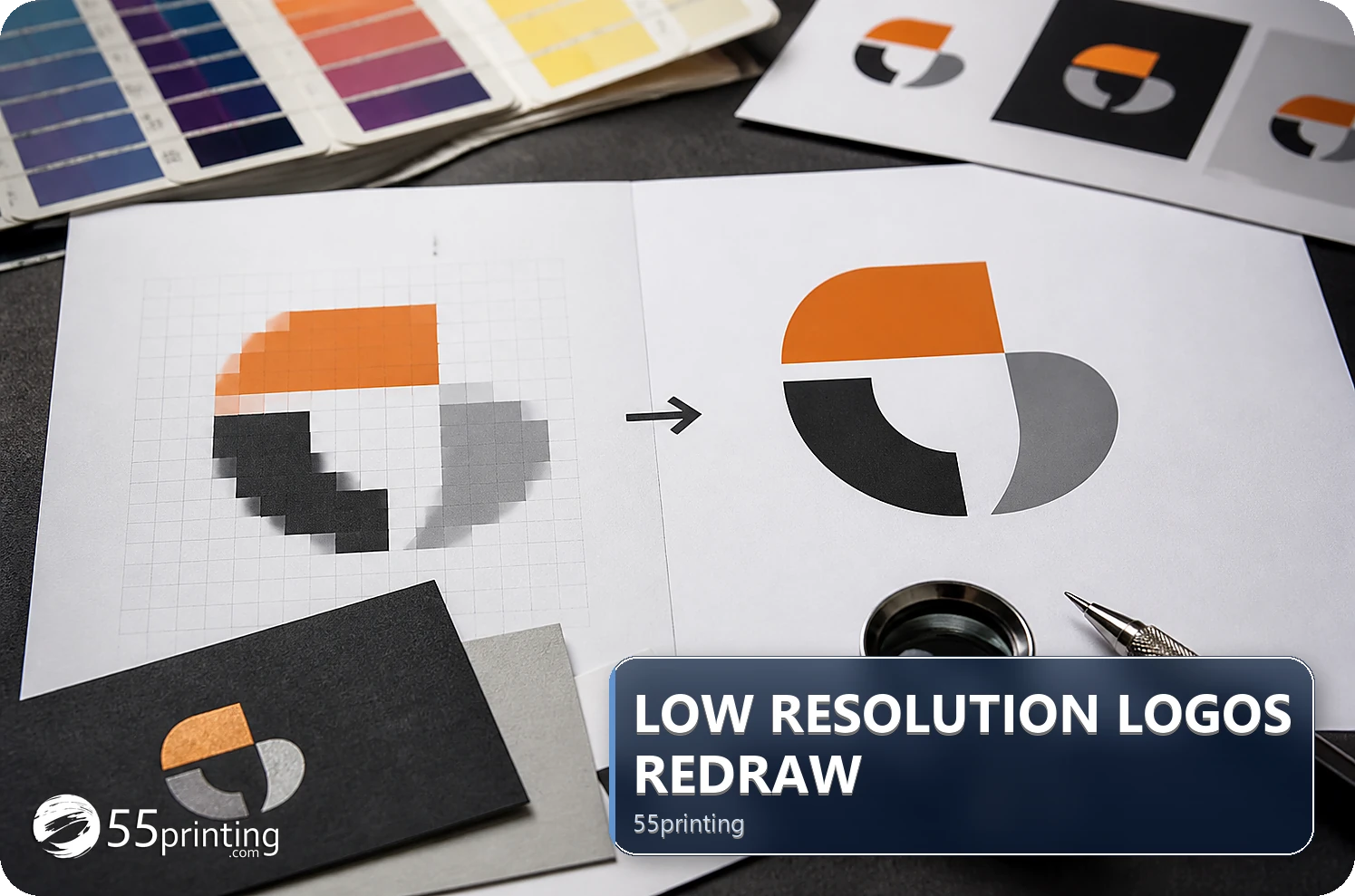
Inspect the logo in the actual product context and classify the problem: supported source cleanup, missing source detail, identity uncertainty, or an acceptable visible limitation. Enhance a supported source defect, request a better source or redraw when exact identity cannot be recovered, and accept a limitation only with approval. Use the current template and proof for the final comparison.
The 55printing Artwork Quality Enhancer route can be considered for a supported source defect, but a tool output is not automatically an approved brand asset. Before you redraw, replace, or accept a soft logo, run the free Print Clear check for effective PPI, print-size fit, and color signals at the size you will actually print. If the weakness is letter edges rather than the mark itself, the blurry text worker sharpens type in place and does not invent a new logo. Keep the original logo, record its authority, map the product with the current template, and use the proof path to compare identity, crop, placement, and detail.
What makes a low-resolution logo risky?
Resolution is one symptom. The larger questions are whether the logo’s identity, exact lettering, proportions, colors, transparency, and source authority are known. A logo can be visibly soft yet correct, or sharp yet wrong. Classify the source, product, intended display size, protected identity, and exact detail before choosing enhancement, replacement, redraw, or acceptance.
| Observed state | First check | Likely path | Risk if skipped |
|---|---|---|---|
| Approved source is soft | Does identity and exact detail remain known? | Test supported enhancement, then proof | Cleanup can expose artifacts. |
| Identity or lettering is uncertain | Which source is authoritative? | Request source or redraw decision | A sharper wrong mark is still wrong. |
| Approved replacement exists | Does it match the brand source? | Use the named replacement, then proof | Unapproved substitute enters the file. |
| Visible limitation is accepted | Who approved the limitation? | Record acceptance and proof context | Expectation is left undocumented. |
How should redraw, replace, and accept be compared?
Redraw is a design and identity decision; replacement uses an approved alternate source; acceptance is an approval of a visible limitation. Enhancement is a source-treatment option, not a substitute for any of these decisions. Keep each path tied to the product, intended viewing context, exact logo identity, and proof question.
- Find the authoritative logo source.
- Inspect lettering, proportions, colors, and transparency.
- Record the product and intended context.
- Test only a supported source action.
- Request replacement or redraw when identity is uncertain.
- Proof the selected logo in the product.

What should the logo handoff note include?
Name the logo source and version, product, side, intended size or context, exact lettering, approved colors, transparency requirement, requested action, and proof question. State whether the output may alter the mark or must preserve it exactly. Use the File Uploader when source context and a documented decision are needed.
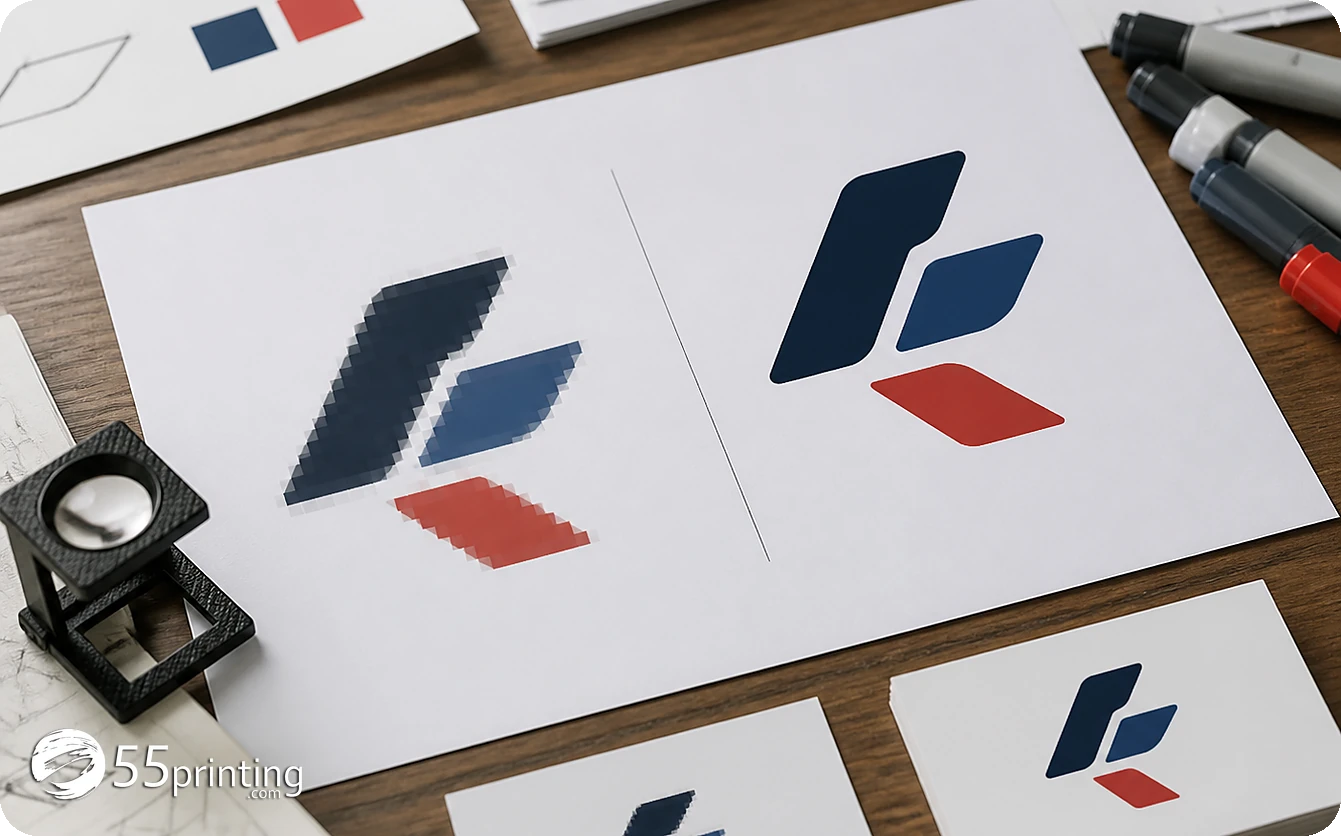
What should proof compare?
Compare exact lettering, logo proportions, color role, transparency, crop, placement, product size, bleed, safe zone, and visible detail. Compare the proof with the authoritative source and record whether the result is enhanced, replaced, redrawn, or accepted. If the mark changed unexpectedly, stop the handoff and reopen the source decision.
Which logo situations need extra care?
Soft approved logo
Test a supported enhancement, compare lettering and proportions with the source, and proof the actual product placement. Stop when artifacts or missing detail alter the identity.
Unknown web logo
Request an approved brand source or make a redraw decision. Do not treat a clearer screenshot or web download as proof of the correct mark.
Small logo near an edge
Use the current product template and proof crop, safe zone, placement, and visual detail. Product geometry can create a separate risk from the source resolution.
Questions customers ask
Should a low-resolution logo be redrawn?
Redraw when identity, lettering, proportions, or important detail cannot be verified from the available source. A redraw is a brand decision, not an automatic enhancement step. Keep the original as reference, provide approved identity guidance, and proof the new mark in the product context.
When is replacement better?
Replacement can fit when an approved alternate logo source exists and its identity, colors, proportions, and intended use are confirmed. Name the replacement version and compare it with the brand authority. Do not substitute a stock or web image merely because it appears sharper.
Can enhancement fix a logo?
Enhancement may improve visible softness or compression in a supported source, but it cannot reliably create missing pixels, exact lettering, vector identity, or approved colors. Compare the output with the source and request a better asset or redraw when important identity detail remains uncertain.
Can I accept a soft logo?
You can record acceptance of a visible limitation when the identity is correct, the product context is understood, and the responsible approver accepts the result. Name the limitation and proof context. Do not let silence become approval for a mark that has not been verified.
What should the logo note say?
Name the source and version, product, side, intended context, lettering, proportions, colors, transparency, requested action, and proof question. State whether the output may alter the mark. This tells the reviewer whether the job is enhancement, replacement, redraw, or documented acceptance.
Does a larger DPI label fix detail?
A metadata label does not create missing source pixels, exact lettering, vector edges, or identity authority. Inspect useful detail and compare the file with the approved source. Request a better asset or redraw when the logo cannot support the product decision.
Does proof approve logo identity?
Proof can reveal placement, crop, visible detail, color role, and product context. It cannot decide whether an unknown mark belongs to the brand. Supply the authoritative logo source, compare the proof with it, and record any redraw, replacement, or acceptance decision.
What if the logo is near an edge?
Check the current product template for bleed and safe-zone behavior, then compare crop, placement, proportions, and visible detail in proof. Edge risk is separate from resolution. A sharp logo can still be placed where trimming or product geometry makes it unsafe.
Preserve identity authority, classify the source limitation, select enhancement, replacement, redraw, or acceptance, and proof the result.