

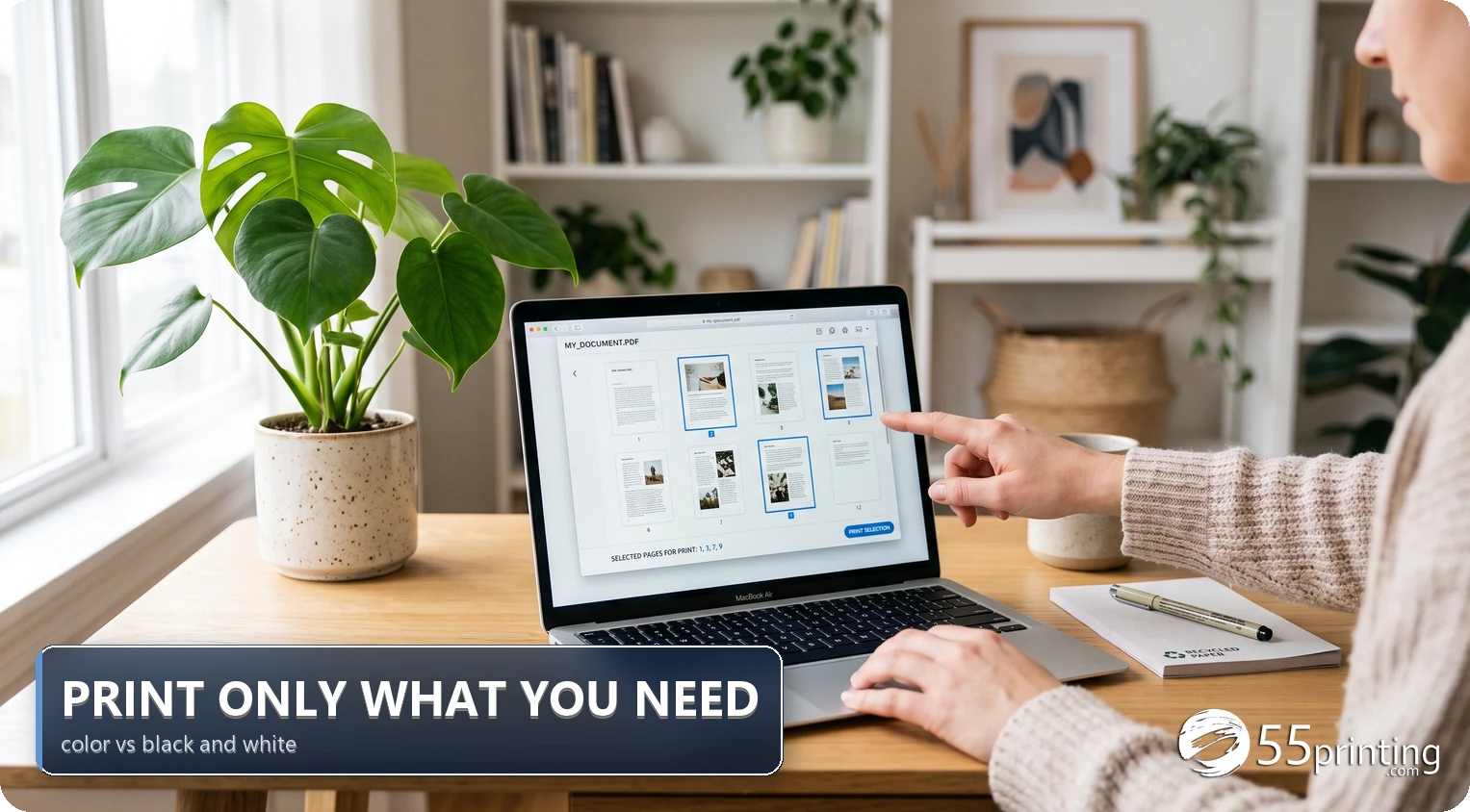
Printing has an environmental cost whichever way you do it, and most of the advice online stops at buy a greener printer. For a business or a school that orders copies, the bigger levers are the ones inside the file: how many pages, how many of them need color, and whether anything has to be printed twice. This guide covers what differs between color and black and white, and the habits that cut waste without cutting quality.
Color vs black and white: what actually differs
Color printing uses several toners or inks where black and white uses one, so a color page generally consumes more supplies. The energy and waste per page depend on the machine, the coverage, and the paper, and published figures vary a lot between devices, so be wary of any single number that claims to settle it. For paper stream context, see the EPA paper and paperboard recycling facts. As a practical rule, black and white is the lighter choice for text, and color is worth its cost when it carries meaning: a logo, a chart, a map, a photo.
Coverage matters as much as mode. A mostly white page with one small logo uses far less color than a full-bleed photo page. That is why a short color cover on a long black and white body is both the cheaper and the lighter way to print a packet.
The reprint is the biggest avoidable waste
A page that has to be printed twice doubles its paper, toner, and shipping. Most reprints come from the file, not the press: a landscape page that came out sideways, a logo exported at low resolution, colors that shifted because the document was built in RGB, or an odd page count that left a blank back on a two-sided run.
Each of those can be caught before printing. Color Profile Check reports whether the PDF is RGB or CMYK. Print Clear shows the effective PPI at the finished size so a soft image is a surprise on screen, not on paper. Rotate Files turns a sideways page in the browser, and PDF Duplex Readiness flags an odd page count before a double-sided order. These tools are free with a 55printing account. Every 55printing order also includes a PDF proof before production, which is the last chance to catch a cropped margin or a wrong size.
Print only what is in the file
Trim the PDF before you upload it. Remove the pages nobody needs, such as a blank last page, a duplicate cover, or a draft appendix, because every extra page is multiplied by every copy. A 12-page packet with one unneeded page, printed 50 times, wastes 50 sheets.
The online color and black and white copies forms help with the count. You can type a page count to see a price first. When you attach the PDF, the form reads the page count from the file and locks it, so the order matches the document you meant to print. Sets is how many complete copies you want. If you change the file, upload the new version and the count follows it.
A split that keeps color where it matters
Decide page by page instead of file by file. Color pages carry the message and black and white pages carry the detail.
| Page type | Print it in | Online print total for 99 pages |
|---|---|---|
| Cover with logo and photos | Color | $14.71 |
| Charts and maps that rely on color | Color | $14.71 |
| Text appendix | Black and white | $6.32 |
| Forms and worksheets | Black and white | $6.32 |
Totals are live 55printing cart print totals for letter size on 24 lb bond, single-sided, before shipping, checked October 14, 2026. The color form currently has a temporary minimum of 50 total prints, so a 99-print order clears it. Black and white copies have no minimum.
Paper, sides, and run size
Print on both sides when the document allows it, because a 20-page PDF printed double-sided is 10 sheets. Choose heavier paper only when the job needs it. At 55printing, 32 lb bond adds 2.2 cents and 100 lb gloss text adds 6 cents per page, as of October 14, 2026, so the heavier stocks cost more and use more material.
Plan one run instead of many small ones. One order ships in one box, and one approved proof covers the whole run. If the document is used every semester, save the approved PDF and reorder the same file instead of redesigning it, which avoids the reprints that come from fresh mistakes.
A short checklist
Set black and white as the default and choose color on purpose. Remove pages nobody needs before upload. Check the file for color mode, resolution, rotation, and odd page count. Approve the PDF proof before production. Reorder the approved file next time. The most sustainable print is often the one you did not make, so keep the digital copy for anyone who does not need paper.
2026 Color & B&W Copy Price Comparison Sheet (PDF)

Upload the PDF. The form reads the page count from the file, then you see the live total before you pay.
Color vs black and white printing FAQ
Is black and white printing always better for the environment?
Generally it uses less toner, so it is the lighter choice for text pages. It is not always the right choice, because a chart or map that is unreadable in gray gets reprinted. Use color where it carries meaning and black and white everywhere else.
Does double-sided printing save paper?
Yes. A 20-page PDF printed on both sides is 10 sheets. Check that the page count is even first, because an odd count leaves a blank back on the last sheet. The free PDF Duplex Readiness tool flags that with a 55printing account.
How do I avoid reprints?
Check the file before printing: color mode, effective resolution, page rotation, and odd page count. Then approve the PDF proof before production. Most reprints come from the file, not from the press. One wasted 99-page color reprint is another $14.71 in paper and toner before shipping.
Do I have to type the page count when I order copies?
You can type a count to price the job first. After you upload the PDF, the copies form reads the page count from the file and locks it, so the order matches the document. Sets is the number of complete copies. Checked on the live color copies form October 16, 2026.
Is color always worse for the environment than black and white?
Color generally uses more toner, so text pages are lighter in black and white at 6.4 cents versus 14.9 cents in color. A chart that is unreadable in gray gets reprinted, and that reprint wastes more than the color page would have. Use color only where the color carries the meaning.
Does printing on both sides cut the paper use?
Yes. A 20-page PDF printed on both sides is 10 sheets. Check that the page count is even first, because an odd count leaves a blank back. The free PDF Duplex Readiness tool flags that odd count with a 55printing account before you order.
Should a long handbook be printed in color?
Usually no. Keep the cover and the charts in color and the text pages in black and white. Ninety-nine color pages are $14.71 and 99 black and white pages are $6.32, both before shipping, checked October 14, 2026. That split saves money and toner on the pages that do not need ink.
What is the most useful sustainable step before I order?
Delete the pages nobody will read, then upload the trimmed PDF. The copies form reads the page count from that file and locks it, so you do not pay for a blank last page times every set. Approve the proof once and reorder that same file next semester.