

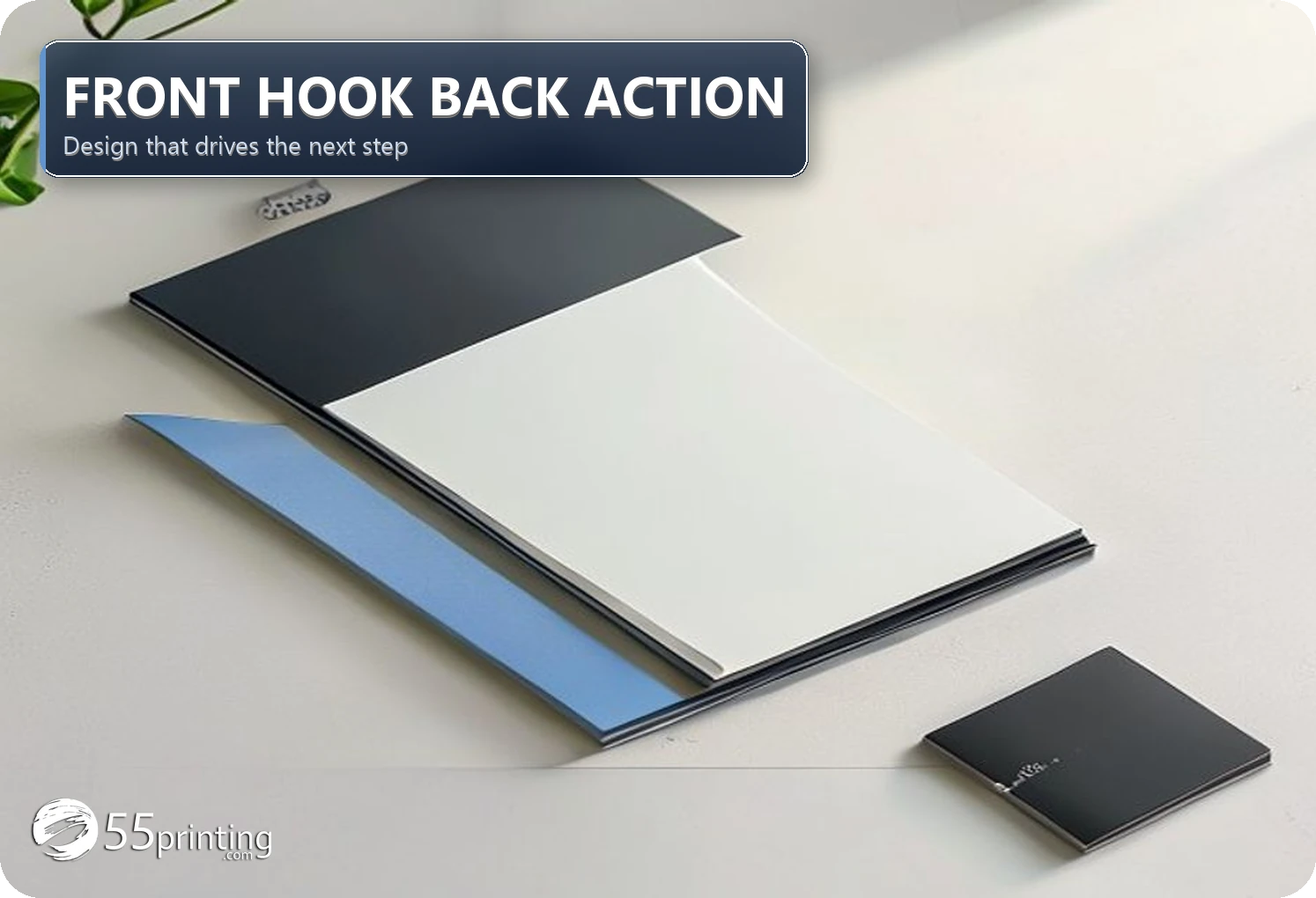
Postcard design rules are simple when the card has one job. The front earns a second look. The back drives one action. Everything else is decoration that steals space from the mail panel or the offer. This page owns creative hierarchy for 55printing postcards; technical panel measurements stay with current templates and USPS guidance.
Front hook versus decoration

- One promise or offer a mailbox glance can parse.
- One brand mark large enough to recognize.
- No competing headlines fighting for the same eye line.
- No fake urgency badges that cover the real offer.
If the front needs a paragraph, the offer is too complex for the face. Move details to the back action panel or a landing page.
Back action panel
| Zone | Allowed content | Blocked content |
|---|---|---|
| Message / offer | One CTA, short proof, offer terms | Five competing buttons |
| Contact tokens | Phone, URL, or QR tied to the CTA | Tokens inside clear zones |
| Mail panel | Address and postage elements per template | Offer copy and QR codes |
Technical clear-zone measurements belong on current templates and postal guidance, not as invented coordinates copied from old jobs. Review print-and-mail handoff when addressing and entry are part of the job.
Size and copy-fit context

| Size | Archived print cell | Copy-fit cue |
|---|---|---|
| 4×6 | $29.2824 | Short hook + short action |
| 5×7 | $36.5246 | Room for terms or secondary line |
| 6×9 | $56.3598 | Larger hierarchy, still one CTA |
Larger size is not permission for denser paragraphs. It is permission for larger type and cleaner spacing. Confirm live sizes on postcard printing before locking artboards.
Hierarchy proof checks
- Hold a 100 percent print at arm length. Read the hook in under two seconds.
- Cover the decoration. The offer and action must still make sense.
- Count CTAs. More than one primary action fails the worksheet.
- Mark the mail panel with a blank rectangle and confirm nothing important sits inside.
- Scan any QR and dial any phone from the proof.
Honest limitation: no conversion-rate claims, Design Studio constraints, or exact mail-panel millimeter maps are established here. Live templates control production geometry.
Write the hook sentence before opening the design file. If that sentence needs clauses and commas to make sense, the front will fail at mailbox distance. Put the dependent details on the back next to one action, then rebuild size and quantity on the live 55printing postcard form so archived cells stay labeled context.
Select size, stock, sides, and quantity after the hierarchy proof passes.
Postcard design rules FAQ
What belongs on the front versus the back of a postcard?
The front carries one hook and clear brand recognition. The back carries one action plus the short support needed to complete that action, while leaving the mail panel clear. Long stories belong on a landing page. If both sides try to sell five offers, hierarchy collapses and tracking becomes ambiguous.
How many competing calls to action should a postcard carry?
One primary action. A secondary path such as a phone under a URL is acceptable only when it supports the same job. Competing “call, click, visit, and redeem” stacks without priority fail the arm-length test. Decide the one result you need before designing.
How does size choice change copy length?
Smaller cards need shorter lines and larger type. Larger cards can hold a secondary support line, not a brochure. Archived 100-piece cells of $29.2824, $36.5246, and $56.3598 for 4×6, 5×7, and 6×9 are size-context history only. Recheck live sizes before writing final copy denser than the face can hold.
How should the design respect the mail panel?
Treat the address and postage area as reserved. Do not place offers, QR codes, or critical legal lines in clear zones. Use the current template for the chosen size. Do not copy coordinates from a previous unrelated job. When mailing service is involved, confirm panel treatment with the current handoff scope.
Where should QR codes and phone numbers sit?
Place them with the action hierarchy on the message side or in a safe message zone on the back. Keep them scannable and readable after trim. Test on a physical proof. Tracking tokens belong with the offer, not inside postal clear areas that can reject or obscure the piece.
What proof checks catch weak hierarchy?
Arm-length reading, single-CTA count, mail-panel masking, and live token tests catch most failures. Ask a second person what the card wants them to do. If answers differ, rewrite before print. A production proof cannot fix a confusing offer structure.
What archived size cells frame copy-fit decisions?
At 100 pieces on the archived configuration, 4×6 was $29.2824, 5×7 was $36.5246, and 6×9 was $56.3598, checked July 30, 2026. Use them only as historical size context. They do not include postage or prove current stock names. Rebuild on the live 55printing form.
Which URL should be used to print the design?
Use /postcard-printing/ after the hierarchy worksheet passes. Recheck size, stock, quantity, and destination there. Keep technical mail-panel setup aligned with current templates, and keep response tracking on its own plan when tokens are required for version testing on 55printing.
Proof the hook and the action as two jobs
Front design wins attention; the back converts it. Treat them as separate proofs so a pretty face does not hide a weak reply path.
- Read the front at arm length first: the main claim should register in under two seconds without magnifying.
- Flip and mark the action zone: phone, URL, QR, or store hours must sit outside the address clear area.
- Test one QR or short URL on a phone camera before the full run; a pretty code that does not open wastes the mail piece.
- Keep one offer only. Two competing CTAs on a small card usually cut response more than they add options.
- If handwriting is required on the back, verify an uncoated or writable path on the live form instead of guessing from a glossy mockup.
Approve the front and back as a pair only after both jobs pass. A strong hook with a buried action is still a weak mailer.
Practical note for Postcard Design Rules: Front Hook, Back Action: write the constraint you are solving on a sticky note before you click approve. If the note names a mail date, a route count, a reply channel, or a list source, verify that one fact on the live form or primary source the same morning. That single habit prevents most reprint waste on jobs like this.
Keep the sticky note with the proof PDF until the job ships. When a teammate asks why a size, stock, or quantity was chosen, the note plus the dated screenshot is faster than rebuilding the decision from memory.
If two people share approval rights, require both initials on that sticky note. Shared approval without a written constraint is how EDDM and postcard reprints usually start.