

LAST UPDATE: 09 / 17 / 2026
We translate artwork to another language and keep your colors, font style, and layout while AI plus a human rebuild the words. A New York customer sent three English flyers this week and got three Spanish backs at no charge. Upload any file to start the same path.
A long-time customer in New York emailed three flyer designs he already loved. All English. He wanted the backs rebuilt in Spanish with the same colors, and he asked which size would print best. By the end of one working session he had three Spanish backs that mirror each front’s palette, plus live pricing for every size on the flyer form. That is what it looks like when a print shop can translate artwork to another language as a normal Tuesday task, not a two-week agency quote.
What it means to translate artwork to another language
Most people picture a phone app pointing at a menu and floating words over the photo. That is an overlay. It helps a tourist read a sign. It does not produce a file a press can print. When we translate artwork to another language, we rebuild the piece: every text block is read, translated in context, and set again in the same palette, the same type feel, and the same layout rhythm. The output is a print-ready file, not a screenshot with captions.
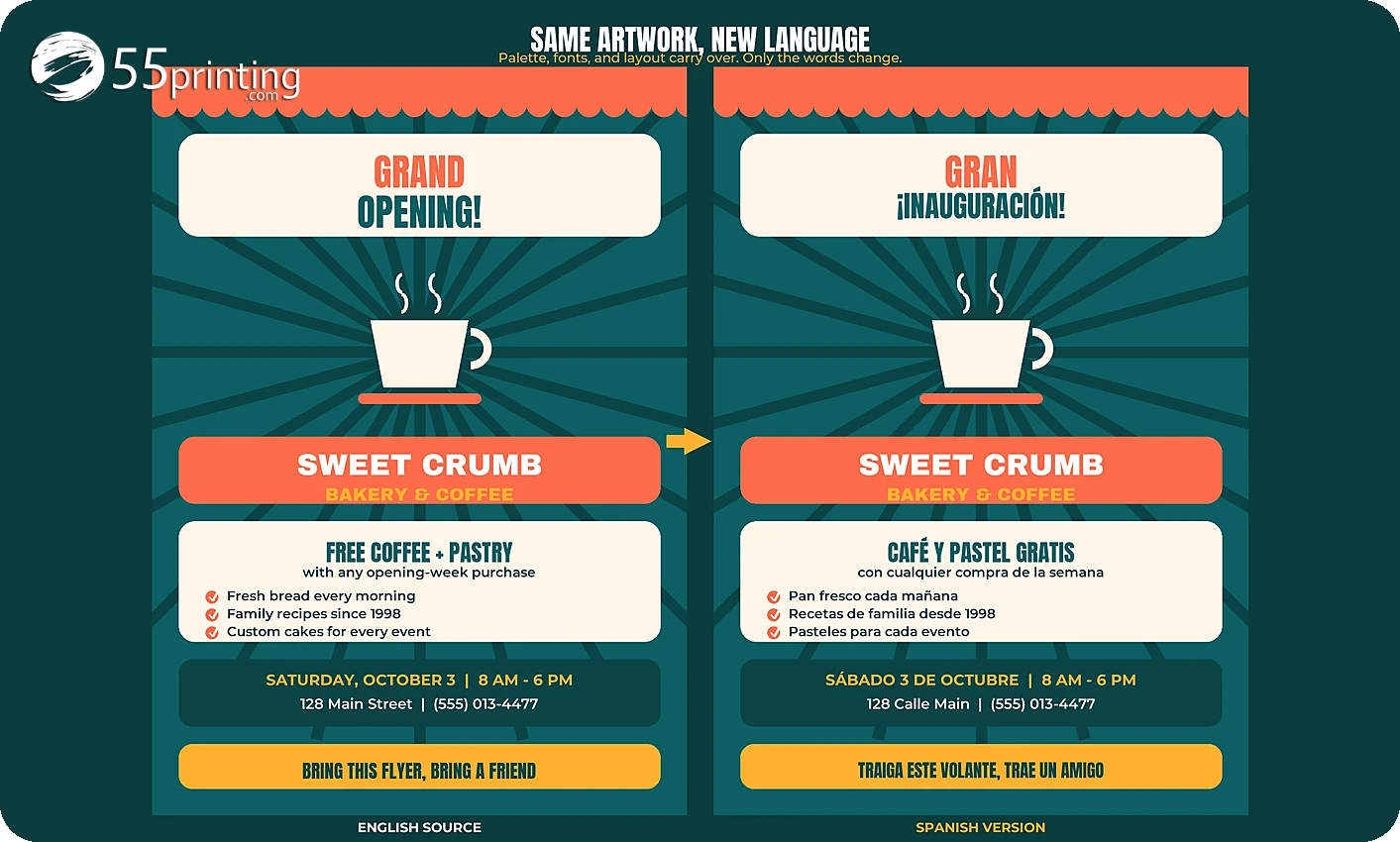
The job is closer to a bilingual rebuild than to a document translation. Your headline still sits where your headline sat. Your brand yellow is still your brand yellow. A visitor who saw the English version and later picks up the Spanish version should feel they are holding the same piece. Because they are.
The real job we ran this week
The customer sent his three flyers as phone screenshots, roughly 1,080 pixels wide. Good enough to read. Not good enough to print. The first pass ran each design through our AI enhancement path, which rebuilds soft art to print resolution while protecting letterforms and flat color. The fronts came back crisp at 4x the pixels with colors intact.
Then the language work started. Each Spanish back was rebuilt panel by panel in its own front’s palette. The yellow, purple, and magenta referral design kept yellow, purple, and magenta. The navy and gold night-skyline design kept navy and gold. The yellow, pink, and blue design kept all three. Section order, headline hierarchy, contact lines, and the four-step explainer all mirror the English source. Only the words moved.
| Piece | Sent to us | Returned to him |
|---|---|---|
| Flyer A, yellow and purple | Phone screenshot, English | Enhanced front plus Spanish back, 300 DPI |
| Flyer B, navy and gold | Phone screenshot, English | Enhanced front plus Spanish back, 300 DPI |
| Flyer C, yellow and pink | Phone screenshot, English | Enhanced front plus Spanish back, 300 DPI |
He still picks size, paper, and quantity. The pricing we pulled the same day from the live flyer form: 2,500 pieces at 5 x 7 on 100 lb gloss runs $126.29 before shipping and tax, 4 x 6 runs $128.51, and 8.5 x 11 runs $272.08. His design work, all three backs, cost him $0.
How the artwork translation pipeline works
Every conversion runs the same five steps. AI does the heavy lifting. A person checks the result before anything moves toward press.
- Enhance. Low-resolution sources get rebuilt to print resolution first. Translating a blurry file just gives you a blurry file in two languages.
- Read. Every text block is identified: headlines, body copy, prices, phone numbers, legal lines. Contact details are flagged as frozen content that must not change.
- Translate in context. The copy converts with the marketing intent attached, not word by word. A headline stays a headline.
- Rebuild. The translated copy is set back into the design with the same palette tokens and a matching type family. Spanish runs about 15 to 25 percent longer than English, so line breaks and panel sizes get re-balanced.
- Human check plus proof. A person compares the two versions side by side, then the translated piece goes through the normal digital proof so you approve the exact file we print.
That last step is the part pure software skips. An app can hand you pixels. It cannot tell you whether the piece will survive a 5 x 7 trim or whether your phone number stayed on the right side.
What survives when we translate artwork to another language
The point of the service is that the design identity carries over untouched. This table is the checklist we hold every conversion against.
| Element | What carries over | How we hold it |
|---|---|---|
| Color palette | Exact hex values, gradients, accents | Palette is read from the source and reused token for token |
| Font style | Weight, mood, condensed vs wide feel | Matching type family per block, or your font file if you send it |
| Layout rhythm | Panel order, hierarchy, spacing logic | Same section map, re-balanced for text length |
| Contact lines | Phone, email, address, social handles | Frozen content. Never translated, never retyped |
| Logos and art | Marks, icons, photos, illustrations | Left in place. Text inside a logo can be rebuilt on request |
| Print specs | Size, bleed, resolution, color mode | Output at final size and 300 DPI or better |
If any row cannot hold, we say so before the work starts instead of handing you a close-enough file. That is the difference between a tool and a shop.
Jobs that already use this path
The referral flyer is one pattern. The same conversion runs on almost every product in the catalog, in any written language pair.
| Who sends it | Typical job | Product |
|---|---|---|
| Restaurants and food trucks | English menu or flyer to Spanish, or the reverse | Flyers, menus, window graphics |
| Churches and community groups | Event flyer in the congregation’s language | Flyers, postcards, banners |
| Service businesses | Bilingual card or mailer, English one side | Business cards, EDDM postcards |
| Clinics and offices | Intake or notice piece patients actually read | Flyers, brochures, letterhead |
| Landlords and property managers | Notice and welcome pieces per building language | Letter copies, door hangers |
| Event organizers | Tickets, banners, signage for mixed crowds | Tickets, vinyl banners, yard signs |
An EDDM postcard is a natural fit: the carrier route picks the neighborhood, the artwork picks the language the neighborhood speaks. A bilingual business card does the same job at handshake distance, English on the front, a second language on the back. Menus, door hangers, and multi-page color copy packets all take the same path.
When it is free and when it quotes like design work
Most conversions land inside free design setup, which means most customers pay $0 for the translation itself. The three Spanish backs this week were free. The rule of thumb is simple: if the piece is a normal single-sided or two-sided print job and your copy converts cleanly, the language work rides inside the design help we already include.
Flyers, postcards, business cards, banners, and two-sided pieces where the copy converts cleanly. Translation rides inside free design setup before you approve a proof.
Multi-page booklets, full catalog rebuilds, or a source so damaged it needs a full redesign first. We name the number before work starts, never after.
You see the scope up front either way. Nothing converts silently and nothing bills silently.
What to send us to start
To translate artwork to another language, any of these work: a print-ready PDF, a JPG or PNG (even a screenshot), a Word file, or just the words and the logo with a note about the size. Tell us the target language and which lines must stay frozen, like phone numbers, addresses, prices, and license lines. For scripts that substitute badly, such as Arabic, Korean, or Chinese, a PDF with outlined type or the font file makes the lock-in exact.
From there the path is normal print-shop rhythm. We convert, you get a digital proof, you check every name and number in the new language, you approve, we print and ship. The File Uploader takes files up to 2 GB and accepts notes in your language too.
Download the translation-ready checklist

Questions people ask before sending artwork to translate
Can you translate artwork to another language if I only have a photo or screenshot?
Yes. That is exactly what this week’s job was: three flyers that arrived as phone screenshots around 1,080 pixels wide. The enhancement pass rebuilds the art to print resolution first, then the language work runs. A sharper source gives a sharper result, but a readable photo is enough to start most jobs.
Which languages can you convert between?
Any written pair. English to Spanish is the most common, but we handle the languages our customers bring: Portuguese, Haitian Creole, Chinese, Arabic, Korean, Vietnamese, Polish, and more. Scripts that substitute badly when a machine swaps fonts, like Arabic or Chinese, are safest when you send a PDF with outlined type or the font file.
Do my colors and fonts really stay the same?
Colors carry over exactly: the palette is read from your file and reused token for token. Font style carries over as a matching family with the same weight and feel; send the licensed font file if you need the identical face. Layout rhythm, panel order, and hierarchy all mirror the source. You judge the result on a digital proof before anything prints.
Is translating my artwork really free?
Usually, yes. Most conversions ride inside free design setup: flyers, postcards, business cards, banners, and two-sided pieces where the copy converts cleanly. The three Spanish backs described in this article cost the customer nothing. Large multi-page rebuilds or heavily damaged sources can quote as design work, and we name that number before work starts.
How fast is the turnaround?
Record time is the honest description. The three Spanish backs in this article were rebuilt inside one working session, and the pricing for every size went back the same day. Simple two-sided pieces are typically same-day or next-day for the converted file. Multi-page or multi-language batches take longer, and your proof still controls when printing starts.
Can one printed piece carry two languages?
Yes, and it is one of the most common requests. English on the front and a second language on the back is a normal business card, postcard, or flyer. An EDDM mailer can carry a neighborhood language with a short English line. Mark which side or panel uses which language in your upload notes and confirm both on the proof.
What file types work best for artwork translation?
A print-ready PDF is ideal. JPG, PNG, and Word files work. Phone photos and screenshots work too because the enhancement pass rebuilds resolution first. Whatever you send, include the target language and note which lines stay frozen: phone, email, address, prices, license numbers. Font files make the match exact.
Will I see a proof before you print the translated version?
Always. The converted file goes through the same digital proof path as any other job. You check every name, number, price, and line in the new language, then approve or request changes. Nothing prints from a conversion without your approval. That review is free and it is the step that makes the service safe for legal or medical lines you must verify yourself.
Upload the file you have, tell us the target language and the frozen lines, and review the converted piece on a free digital proof before we print.